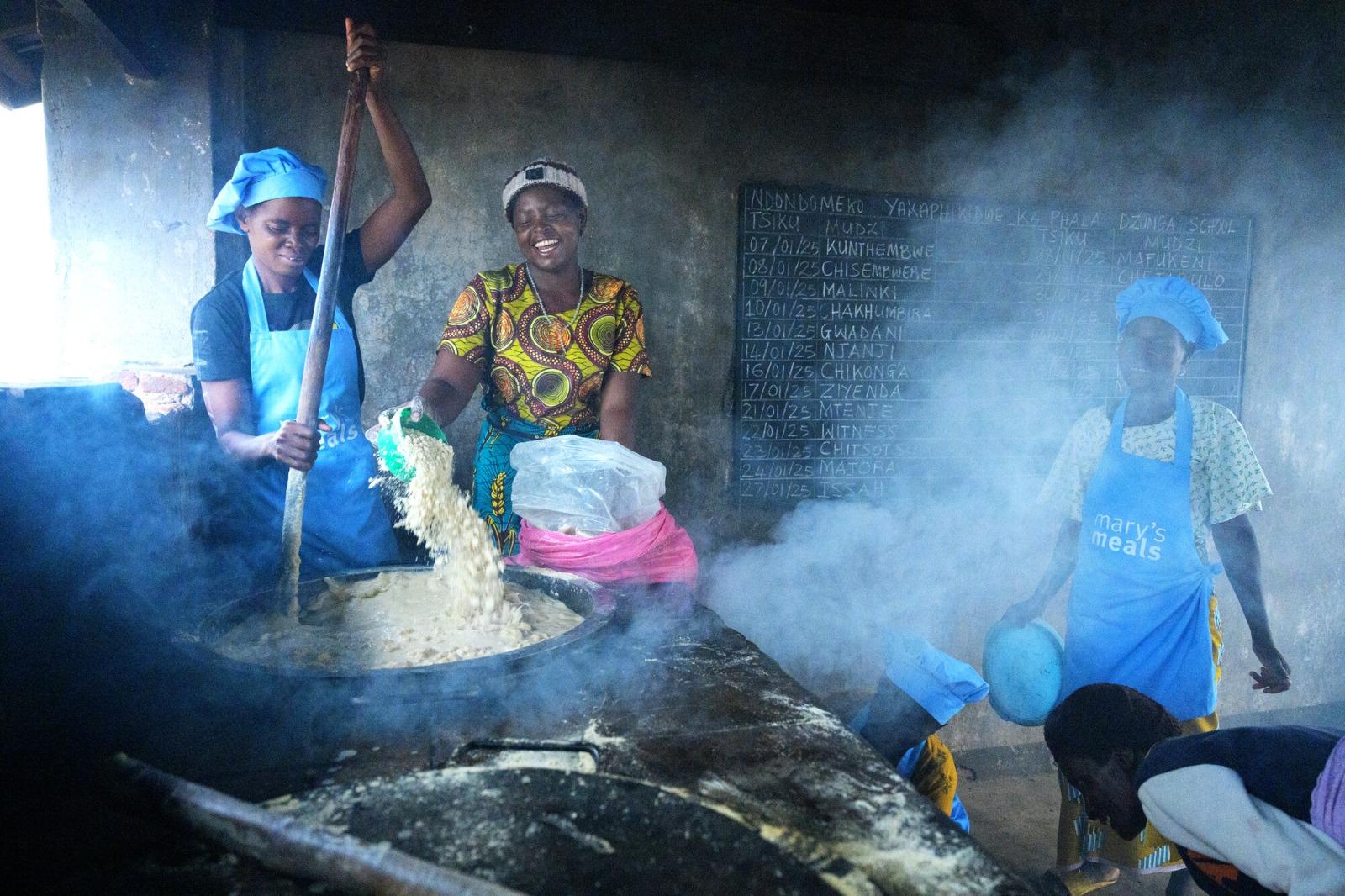
Many Americans grew up on a bowl of Quaker Oats in the morning. Children in Malawi grow up on porridge too – but theirs is likuni phala, a corn-soya blend fortified with vitamins and minerals.
Whatever it’s made of, porridge is one of the world’s go-to ways to start the day with a nourishing meal.
The Scotland-based charity Mary’s Meals reaches more than 3 million children with daily school meals in 16 countries and, wherever possible, makes the meals with locally procured food, supporting the local economy. The charity says it costs about 13 cents per meal, or about $25 to feed a child for a full school year.
The charity is named after Mary, the mother of Jesus. Its founders are Catholic, although it is not an official Catholic organization.
RELATED: Pope Leo receives a mug and shirt from Mary’s Meals while on plane to Africa
People have made porridge for thousands of years, but the first World Porridge Day was held on Oct. 10, 2009, by Mary’s Meals. The charity says around 78 million children of primary-school age are out of school worldwide – and that the promise of a daily meal is one of the strongest reasons for them to go.
Mary’s Meals says for millions of children, families and communities, a mug of porridge is much more than a traditional or fancy breakfast: it’s a vital safety net. The promise of these meals brings children to the classroom, where they can gain an education and grow up – well-nourished and well-educated – to become the men and women who will lift their communities out of poverty.
“The program is good, and if you look at our past Grade 7 and Grade 9 performance, you will see improvement,” said Amon Sakala, the head teacher of Katemo Primary School in Zambia.
“Out of 52 centers, we were ranked number 6, and I attribute that to the porridge, because absenteeism reduced and most learners attended daily,” the teacher added.
In the 10 years since the launch of Mary’s Meals’ school feeding program in Zambia’s Eastern Province, the charity claims a 22 percent increase in the share of children progressing from primary to secondary school across the region.
“Hunger so often stands in the way of children’s readiness to learn, especially in environments where extreme poverty, conflict or displacement is at play,” said Erin Pratley, Chief Programs Officer at Mary’s Meals International.
“What we’ve seen in Malawi, Zambia, and elsewhere is that, when children can rely on a nutritious daily meal such as fortified porridge, they grow stronger – and so do their families and communities, especially when local people are actively involved in the school meal program delivery,” she told Crux Now.
Pratley said that over more than two decades, Mary’s Meals has seen the true power of its school feeding program, which currently operates in 16 countries, working alongside dedicated local communities that are battling hunger.
“What is evident in these environments is that households count on the meal at school for their child and value their child’s education,” she explained.
The backbone of Mary’s Meals is local community members, who invest time and resources in the school feeding program because they see the meal’s tangible benefits and value education for their children’s future.
Coupled with a commitment to sourcing food as locally as possible, school feeding can positively impact children, communities, and countries.
“School feeding programs are playing a key role in the complex fight against hunger and powerfully impacting communities who bear the burden of global hunger – where children always suffer most acutely,” Pratley told Crux Now.
“Even when focusing on the complexities of the issue in hand, it’s important to remember that children just want to be children – and meals served in school give them that chance.”
______
You are reading this Crux Now article for free. You can register for our free daily newsletter here, and you can become a Crux Now supporter for full access to all our premium content here. To find out more about why becoming a Crux Now supporter is a great idea, go here.