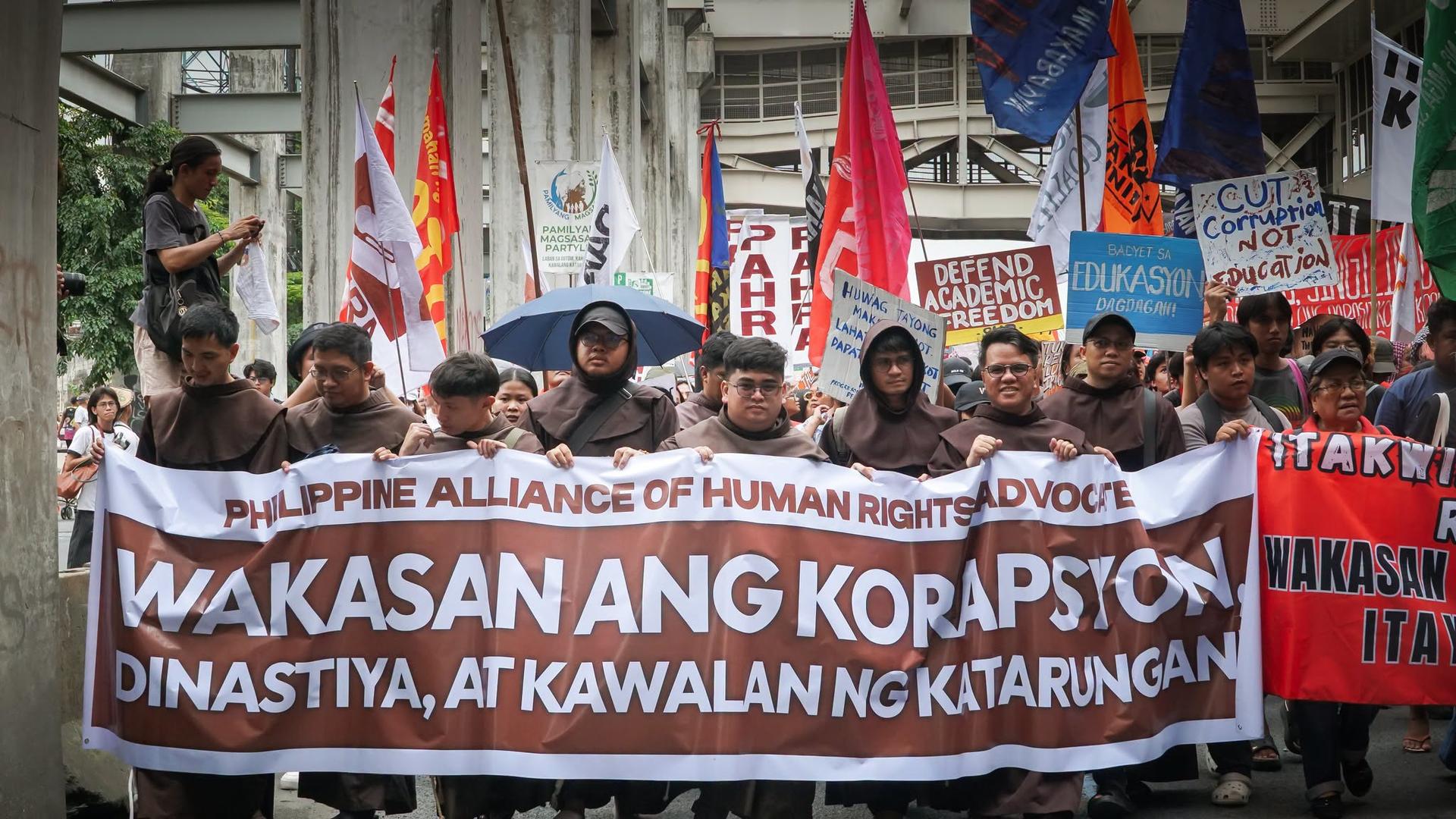
MANILA, Philippines – Protesters from various Christian churches marched along one of the country’s most dangerous highways on Monday, when President Ferdinand Marcos Jr. delivered his annual report to the Philippine Congress.
Religious groups and activists condemned not only corruption in the government but also the United States plan to build a 4,000-acre artificial intelligence (AI) hub in the agricultural province of Tarlac, about 73 miles northwest of the capital Manila.
Police said around 6,000 protesters joined the rallies during Marcos’ fifth State of the Nation Address (SONA) — a speech patterned after America’s State of the Union Address, an annual report on the country’s progress.
The protests were held along Commonwealth Avenue — known as the “killer highway” for its history of car accidents — about two miles from the congressional building where Marcos delivered his annual speech.
Marcos’s SONA this year, which lasted one hour and 25 minutes, was a wide-ranging speech that included initiatives to hold corrupt officials accountable and to provide tax relief for the middle class.
It also mentioned the U.S.’s proposed AI hub in the Philippines, a former American colony (1898-1946) and the oldest U.S. treaty ally in Asia.
The AI hub will be constructed under the Trump administration’s Pax Silica, a flagship program to secure the technology supply chain, including the minerals needed for computer chips.
This effort is expected to reduce reliance on China, which has dominated tech manufacturing.
The U.S. Pax Silica Declaration has been signed by 23 countries, including the Philippines.
Pax Silica in Marcos’ SONA
Marcos said in his SONA that the planned Pax Silica Industrial Hub in Tarlac “will create an ecosystem that will have AI at its core.” He described the Pax Silica hub as “an advanced manufacturing and logistics center in the global AI and technology value chain.”
“It will bring quality jobs to our people, accelerate our industrial competitiveness, and revitalize our economy,” he explained.
Critics have warned, however, that Pax Silica comes at a great environmental cost, as the AI hub is expected to consume huge amounts of water and electricity. Thousands of Indigenous People and farmers also stand to be displaced.
Disputing these arguments, the Philippine government said the water for the AI hub will come from alternative sources, such as rainwater. It also denied that the project will displace Indigenous Peoples.
Still, religious groups are keeping close watch.
The Conference of Major Superiors in the Philippines, a 71-year-old association of religious men and women in the country, mentioned Pax Silica in its open letter to Marcos ahead of his SONA.
The CMSP said it was “deeply concerned” about Pax Silica, which risks “depleting our waters, displacing Indigenous Peoples from their ancestral domains, and exploiting the resources of Mother Earth.”
That is, if the plan is pursued “without ecological justice, transparency, meaningful consultation, and respect for the rights of affected communities.”
“How can there be peace when creation is wounded, and communities are uprooted?” said the CMSP.
Person’s dignity over economic gain
The Church People-Workers Solidarity, an ecumenical group currently chaired by a Catholic bishop, also voiced concern about Pax Silica.
The group’s chairperson Bishop Gerardo Alminaza said that such projects, while offering opportunities for economic growth, “must be carefully evaluated in the light of their impact on workers, local communities, indigenous peoples, the environment, and the long-term interests of the Filipino nation.”
Citing Pope Leo XIV, the Church People-Workers Solidarity said that “authentic human development places the dignity of the person before economic gain and always serves the common good.”
Bishop Dindo Ranojo, general secretary of the independent Christian church Iglesia Filipina Independiente (IFI), echoed the concerns of other religious groups regarding Pax Silica.
Speaking to Crux Now, Ranojo said Pax Silica will negatively affect the people and farmlands of Tarlac because of the potential depletion of water resources. He said the program also endangers the country’s mineral resources, which miners have exploited over the decades.
“Do not push through with Pax Silica because in the long run, its impact will be on the lives of ordinary citizens: farmers and Indigenous Peoples. It also has a negative impact on the environment, and the impact on the future will be even greater,” Ranojo said.