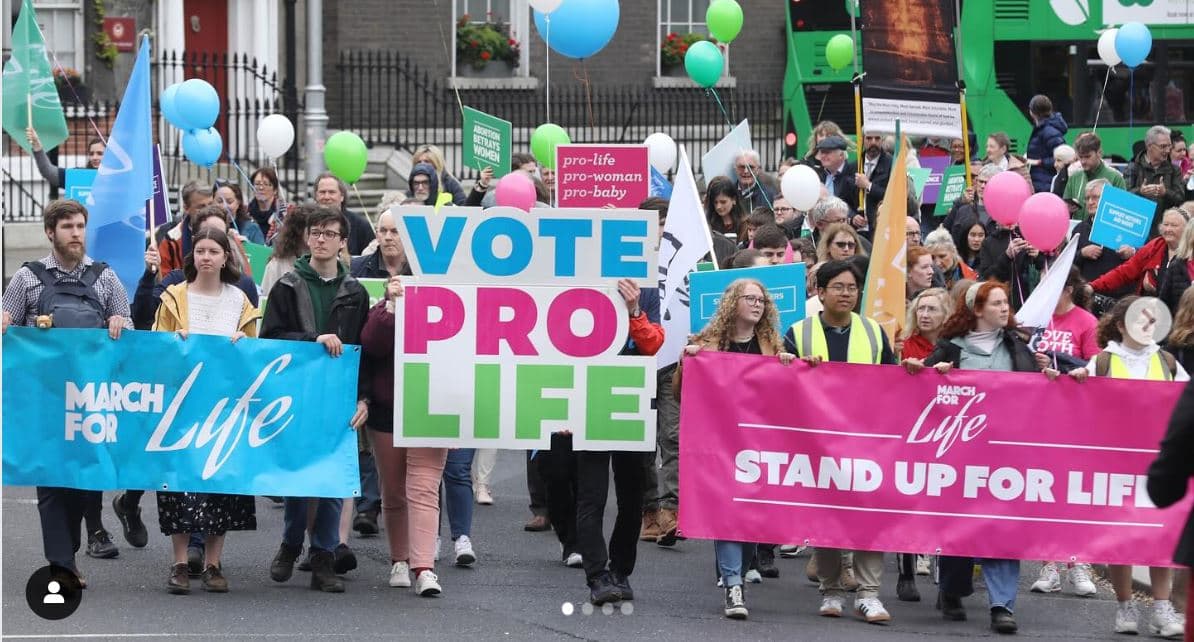
A British woman who has been arrested multiple times for silently praying outside of an abortion clinic, and is now facing new charges, has said that people from the pro-life movement face harsher policing than other groups.
Speaking to Crux Now, Isabel Vaughan-Spruce, co-director of March for Life UK, said that she and other volunteers praying outside abortion centres had faced serious abuse from members of the public which the police did nothing about.
“We had physical assaults caught on camera where you could identify the person committing the assault. You could see the number plate of their car. There were other witnesses there,” she said.
“We would give these videos to the police, and I remember on one occasion I asked the police officer, ‘Why are you not doing anything when we’re being assaulted?’ And he said to me, ‘If you don’t want to be assaulted, you don’t have to come out of your house,’” she explained.
“People talk about two-tier policing now. Those of us who are pro-life have seen that going on for many years, because if the boot were on the other foot, I have no doubt that action would have been taken, and rightly so,” Vaughan-Spruce added.
Vaughan-Spruce recently faced five fresh new charges ahead of a court case in January, to which she pleaded not guilty last week at Birmingham Magistrates’ Court.
She had previously received a £13,000 ($17,200) out-of-court settlement for wrongful arrest and false imprisonment from previous occasions she was arrested for silently praying outside an abortion clinic in Birmingham, UK.
“Our freedom to live out our faith is at stake, and I think quite rightly, people who aren’t of my faith have contacted me saying they are concerned about this too. If we’re saying that Catholics are being singled out for whatever reason and they can’t stop and silently pray: Who’s likely to be next?” she said.
“So there should be fundamental freedoms, and I believe there still are fundamental freedoms that are inviolable,” she added.
“The right to to think what we want on a public street, which is essentially what silent prayer is – it’s just thoughts turned towards God, and our heart turned towards God – shouldn’t be something that’s ever up for being challenged,” she said.
Vaughan-Spruce also explained why she wanted to pray specifically outside of an abortion clinic, saying that being present is an important part of Catholic prayer.
“Then I would say from a Catholic perspective, presence plays an important part of our prayer, and for many Christians as well. So first of all, we believe Jesus became man and became present amongst us. We would say the source and summit of our faith is the real presence of Christ in the Eucharist,” she said.
“What did Mary do when Jesus was being crucified? She didn’t stay at home and pray. She didn’t go to a temple and pray there. She actually went and stood at the foot of her son’s cross in solidarity with him and in love,” Vaughan-Spruce stated.
“I see abortion centers as modern-day Calvarys. The very least I can do is just to be present there, and that presence is very important,” she added.
The full interview with Crux Now and Vaughan-Spruce is below.
The following interview has been edited for clarity and length.
Crux Now: What can you tell us about your case thus far?
Vaughan-Spruce: It probably started about four years ago, in December 2022 when I was first arrested. Prior to that, I’ve been praying near abortion centers for about 25 years. Pre-buffer zones, I was offering help there to women and couples, and many accepted that help.
Local buffer zones, public space protection orders (PSPOs), were brought in around some abortion centers in the country. And one was brought in in Birmingham.
In December of 2022, I was silently praying outside the abortion in Birmingham. No posters, no leaflets, nothing religious on display. I wasn’t carrying a rosary in my hand or holding a Bible or anything, and I wasn’t engaging in any way with anyone.
Police came and arrested me. They asked me: what was I doing there? And I said I might be praying in my head, but nothing out loud, and that was enough for them to arrest me.
I was taken to the police station, locked in a police cell for a while. Eventually, I was questioned under caution, and I was charged with engaging in an act which was intimidating service users, even though the abortion center was closed, so there were no service users. I went to court the following year and was completely acquitted in February 2023.
So about three weeks later, I went and did exactly the same thing. This time, six police officers came with a police van and told me my prayers were an offense. I reminded them that with just silent prayers in my head, they said that didn’t matter, and it was an offense.
They again took me away in the police van. I was in a police cell for a while while being released on bail for six months. Eventually, I was told that case was dropped. But the police continued to come out and give me tickets. I made a claim against the police for wrongful arrest and I was awarded an out court settlement of £13,000 ($17,200).
Then in October 2025, national buffer zones were brought in. Every abortion center had a buffer zone around it. Buffer zones ban certain types of behavior. They don’t ban people. They’re still public streets.
Looking at the wording of the national buffer zone, I realized I was still allowed to silently pray inside that buffer zone. So, I went and did what I’d done before: silently prayed without interacting with anyone or engaging with anyone, or certainly not blocking anyone’s way or anything like that.
Police continued to come out and ask me the same questions week after week after week, and eventually in December last year, I received a charge through the post, and I have now made a plea based on that charge.
As things stand, I’m due to go to court next year at the end of January.
So you received the out-of-court settlement but have subsequently been arrested and charged. Can you help explain that?
So you’d think there would at least be some internal understanding that things have gone wrong to make an out-of-court settlement.
I’m now being charged under the national buffer zone, whereas before I was being charged under the local buffer zone. So before I was being charged for breaking a PSPO, which was the local zone, now I’m being charged with breaking the national buffer zone.
But I would say none of them would affect my rights to carry out my most basic religious freedom to silently pray about what I want. I would say that’s an unqualified right to silently pray.
Someone on the other side of the debate might ask you why can’t you just pray about the abortion clinic outside of the buffer zone. What would your answer be to that?
I’m really glad you pulled that up because quite a few people have mentioned this. There’s two two key points to that. Firstly, were you to say to anyone on the street, “I don’t want you on this street, go somewhere else” – they shouldn’t have to do that.
Even if you don’t want that person on the street for whatever your reason, it’s still a public street. So even if somebody doesn’t want me there, unless I’m doing something which breaks the law, I shouldn’t have to leave just because of that. So that’s one point.
Then I would say from a Catholic perspective, presence plays an important part of our prayer, and for many Christians as well. So first of all, we believe Jesus became man and became present amongst us. We would say the source and summit of our faith is the real presence of Christ in the Eucharist.
Our sacraments are based on presence. We can’t have an online Mass and think we get the same graces as going to the Mass. We have to actually be present with a priest to receive the sacrament of confession. You can’t baptize through the internet.
We go on pilgrimage to places where things might have happened hundreds or 1000s of years ago. In the case of the Holy Land, we believe that being present there is still very important.
People even who don’t share our faith still recognize this. If you were to have a service that was held after an accident or a disaster happened, like 9/11, you might go and have it at that site, or you’d go and lay flowers for someone who was killed in a road accident where they died.
I look to Mary as a role model for myself as a woman. What did Mary do when Jesus was being crucified? She didn’t stay at home and pray. She didn’t go to a temple and pray there. She actually went and stood at the foot of her son’s cross in solidarity with him and in love. As far as we know, she wasn’t remonstrating with any soldiers or anything like that.
I see abortion centers as modern-day Calvarys. The very least I can do is just to be present there, and that presence is very important.
What’s your answer to the idea that your presence there is somehow intimidating or making people uncomfortable?
People shouldn’t be intimidating or harassing people on streets, and I would have never dreamed of doing that. Many people stand or walk or continue their life along these streets. As I say, these streets within the buffer zone are still public streets.
It’s actually a residential street, so there’s many people coming in and out of their houses, etc.
There’s no law saying how long you can’t stop on a public street. Well, we’d be having police questioning people all the time. And to the best of my knowledge, apart from pro-lifers, no one else has been questioned on that street.
How long have they stopped? What are they thinking about when they’ve stopped? What are their reasons for stopping? It’s those people like myself who are Catholic and pro-life who were the ones being singled out to be questioned.
So, what do you think is at stake here then for Catholics and Christians in Western countries?
Our freedom to live out our faith is at stake, and I think quite rightly, people who aren’t of my faith have contacted me saying they are concerned about this too. If we’re saying that Catholics are being singled out for whatever reason and they can’t stop and silently pray: Who’s likely to be next?
So there should be fundamental freedoms, and I believe there still are fundamental freedoms that are inviolable.
The right to to think what we want on a public street, which is essentially what silent prayer is – it’s just thoughts turned towards God, and our heart turned towards God – shouldn’t be something that’s ever up for being challenged.
Where does this desire for a buffer zone in itself come from?
I think it comes off the back of a lot of hearsay and gossip, if I’m quite honest. I run a group called 40 Days for Life in Birmingham, and for many years before buffer zones came into play we’ve been praying and offering help to women outside abortion centers.
So the previous abortion centers we were praying outside closed down in 2019. So we then moved to the abortion center in Kings Norton, which is the one that I’ve since been arrested outside.
And when we first arrived there, we could already see there was some division in the neighborhood. Some people really welcomed us very warmly and offered us the use of their bathrooms in their home or cups of tea.
There were other people who were really aggressive and abusive towards us, and some of my volunteers were threatened and spat at and even had property stolen. There would be cars that would drive down the street at high speed towards people, and even mount the curb, and then veer away at the last second.
We had physical assaults caught on camera where you could identify the person committing the assault. You could see the number plate of their car. There were other witnesses there.
We would give these videos to the police, and I remember on one occasion I asked the police officer, “Why are you not doing anything when we’re being assaulted?” And he said to me, “If you don’t want to be assaulted, you don’t have to come out of your house.”
People talk about two-tier policing now. Those of us who are pro-life have seen that going on for many years, because if the boot were on the other foot, I have no doubt that action would have been taken, and rightly so.
And have you had much interaction with the Catholic hierarchy about your case?
I’ve had a lot of support from the work I do with March for Life. I connected with a lot of priests and some bishops, and I felt really supported by them. In Birmingham, we have a lot of priests who come and join us with the 40 Days for Life.
Bishops that I’ve spoken to have on a personal level been been very kind. I’ve felt very supported by many priests and bishops.
What are the main barriers in the way of building a pro-life culture today?
It’s the case of getting the message out there because there’s a lot of cancel culture around in the UK nowadays, and particularly in places where that message is needed the mos, like schools, universities.
These buffer zones are fostering intolerance in local neighborhoods. We all understand that we have different beliefs, but we need to be sometimes helped to get along with each other, particularly when we’re talking about more emotionally charged topics or sensitive topics.
The answer isn’t to censor people so that they can’t speak at all and to have this cancel culture. We need to try and encourage people from a young age to be able to robustly discuss things without necessarily taking someone else’s disagreement in a personal way.
I think we almost need to go back to teaching in schools how to have a robust disagreement, robust discussion or debate, without feeling so personally slighted that we hate the other person who has different beliefs to us.
Follow Fionn Shiner on X: @FionnShiner92
______
You are reading this Crux Now article for free. You can register for our free daily newsletter here, and you can become a Crux Now supporter for full access to all our premium content here. To find out more about why becoming a Crux Now supporter is a great idea, go here.