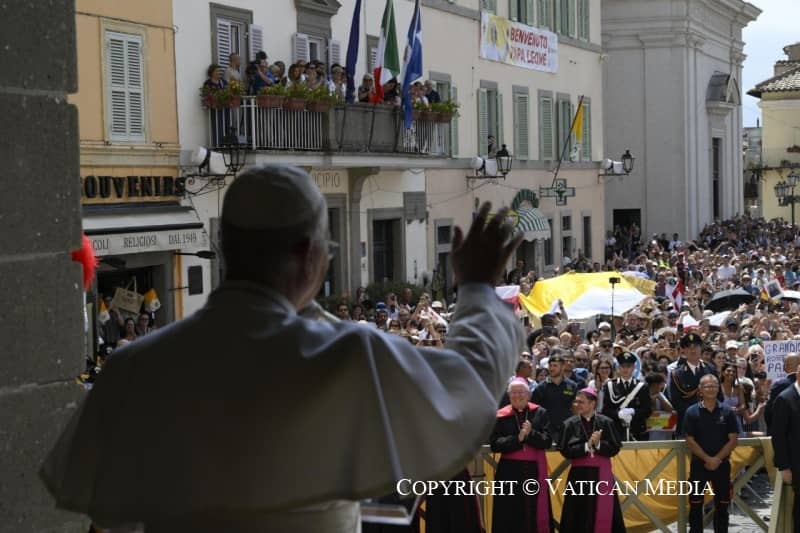
Sometimes, when the pope says something, it becomes news for people far beyond the Catholic world.
The problem is that most people working in the news industry aren’t particularly religious, so they don’t always know how to talk about it.
These are magic moments for those of us in the Catholic news business, because they’re the times we’re invited to explain these stories to an audience we don’t usually reach: People who don’t follow Catholic news. In many cases, they’re also exactly the audience we’d like to have more of—Catholics who don’t regularly watch, read, or engage with Catholic media.
Crux Now‘s Managing Editor, Christopher Altieri, hates “ink-on-ink” journalism, but our publisher, Deirdre Brennan, says that these days, with so much skepticism and negativity toward the press, people want to know how the news is made. So here we go.
Before the COVID-19 pandemic, getting a call to be the “Catholic person” on these stories meant – for me, anyway – hopping in a cab and going down to the local BBC Radio station, which had a room set aside for TV interviews for other news organizations.
Now it means doing things on your computer wherever you happen to be – you’re usually at home, but sometimes you are at a restaurant or even in a soulless hotel room.
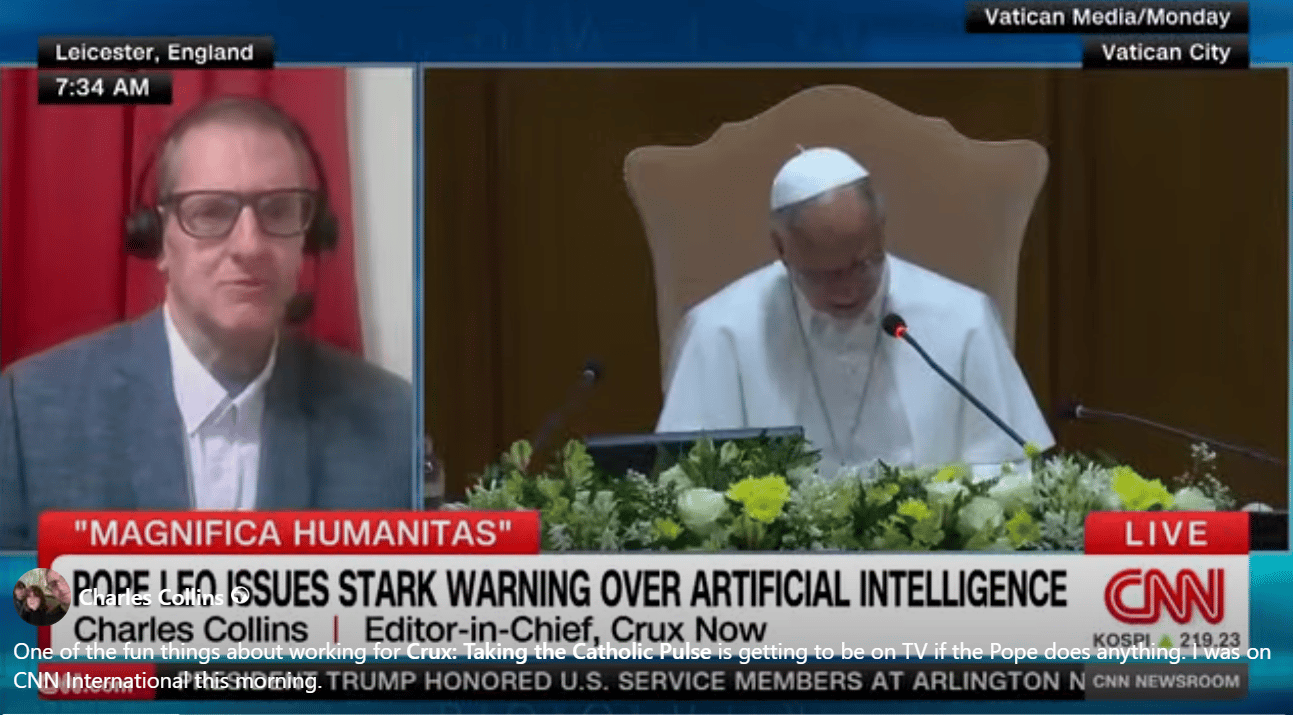
I happened to be in one last week when CNN International asked for an interview about the pope’s release of his first encyclical. It was early morning in the UK, so it was really, really early in Atlanta.
CNN doesn’t tell you what they are going to ask – some folks do – so you have to be somewhat prepared, while knowing you aren’t prepared, and might have to speak on the fly.
In my case, I didn’t really have much in terms of proper clothing, and as it started, I realized I hadn’t spoken to anyone since the day before – I probably should have coughed or gargled salt before the broadcast began.
I also didn’t really have a good spot to sit in the hotel room, and it was way too early to find someplace better that was open – but that is modern journalism, for better or worse.
Being called on to be an “expert” can lead to some strange situations. I’m a Texan who lives in England. A few years ago, I was in a BBC studio to discuss the canonization of a saint when news broke of a shooting in Texas. The interviewer asked whether I could comment on it, even though I hadn’t lived there in decades. Naturally, I said yes. As any journalist knows, having an opinion and having expertise are not always the same thing.
Is it fun doing these things? Absolutely. They’re also a great way to raise Crux Now‘s profile. Just as importantly, they help me learn to communicate in a broader, more accessible way, rather than slipping into the kind of “inside baseball” language we Catholic journalists often use. Most people don’t know what an encyclical is, and in many settings, there’s simply no time to explain it.
In any event, here I was on Tuesday morning—both in England and back in the United States. The view outside would have been spectacular, but the light was so bright that I had to close the curtains. I do miss working from a proper studio.
Still, regardless of the setting, I hope my observations on the pope’s warning about artificial intelligence prove more intelligent than the countless pundits already weighing in on the subject. And heck, I even know what an encyclical is.
(Click video to watch)
CNN: For more on Pope Leo’s landmark publication, I want to bring in Charles Collins, editor-in-chief of Crux Now. Appreciate you joining us.
Collins: Thank you for having me.
So in the first major theological document of his papacy, Pope Leo warns about artificial intelligence, calling for it to be disarmed, putting AI at the very center of his first encyclical. How significant is this, and how exactly does AI get disarmed?
That’s a good question, because no one really knows what’s happening with AI. This document was very open. He didn’t throw AI out the window. What he said was we have to make sure it’s governed properly. And right now, technology seems to be working on its own. You have people running companies just making decisions and seeing where they go. And I think that’s what is concerning Pope Leo. He wants people to be able to make these decisions together, as opposed to being governed by the tech industry.
And in calling for AI to be disarmed, Pope Leo’s aim is to prevent AI from dominating humanity, particularly when it comes to its use in warfare. The pope says AI should be subject to the most rigorous ethical constraints, and the co-founder of anthropic, Chris Oehler, echoed those same concerns at the Vatican Monday. But are other tech bosses listening? Do you think?
No, I don’t think they’re listening. I think they’re fascinated by the technology and they’re seeing what they can do, as opposed to seeing if they should be doing it. He made this statement about disarming AI, and I think people of my age, at least, remember that movie War Games. And that’s what’s concerning a lot of people when you put AI in charge, AI doesn’t have a conscience. But sometimes we think it does because the way it’s programmed, it’s programmed to look like it has a conscience, but it doesn’t. And I think that’s the biggest concern that Pope Leo is raising.
And the pope also touches on the just war concept, calling it outdated. He says military force should only be used for self-defense in the strictest sense. Is that a message specifically for President Trump and his war with Iran? Do you think?
No, I think this has been done since World War II. The introduction of nuclear weapons changed the way just war theory is observed in the Catholic Church, because anything could rise to nuclear arms being used… We don’t want that to happen.
And also, you look at something like Iran, people will make arguments that we’re trying to stop them from having nuclear weapons. But you look at the number of civilians who have been killed in these attacks. You look at how the negotiations are going right now, that they don’t seem like they’re actually preventing anything. What was the use of that war?
And I think that’s what the pope is saying. If we look at these wars, do the outcomes really justify the damage that’s done?
And Pope Leo also offers an apology for the Catholic Church’s delay in denouncing slavery. Why do you think he’s doing that now? And is he offering perhaps a path for the U.S. government to follow suit and do the same?
Well, I think he’s offering it now because there is a new kind of slavery that is emerging, usually affecting women, but also affecting children. And how you define slavery has always been an interesting debate within the Catholic Church and the world itself. If you’re being made to work for 12 hours a day in order to be able to feed your family, is that a sort of slavery? And these are the debates that people are having now, and he wants to make sure the catholic church is on the right side of history.
And in the end, what impact do you think his encyclical will have ultimately on the population? Certainly, the Catholic population across the globe.
I’m not sure these documents ever have a lot of influence. And this one was a bit verbose and tangential. He talked about a lot of things in it. He didn’t really even get into AI until about the second half of the document.
I think what he said was we need to talk about it. And it’s how that conversation goes that people are going to be influenced by. I’m not sure the document itself is actually going to be influential on its own.
It’s what happens in the next two years, five years, ten years. What does the church say and what does AI do in that time? And that’s when we’re going to find out what influence the Church is going to have on the AI issue.
Follow Charles Collins on X: @CharlesinRome