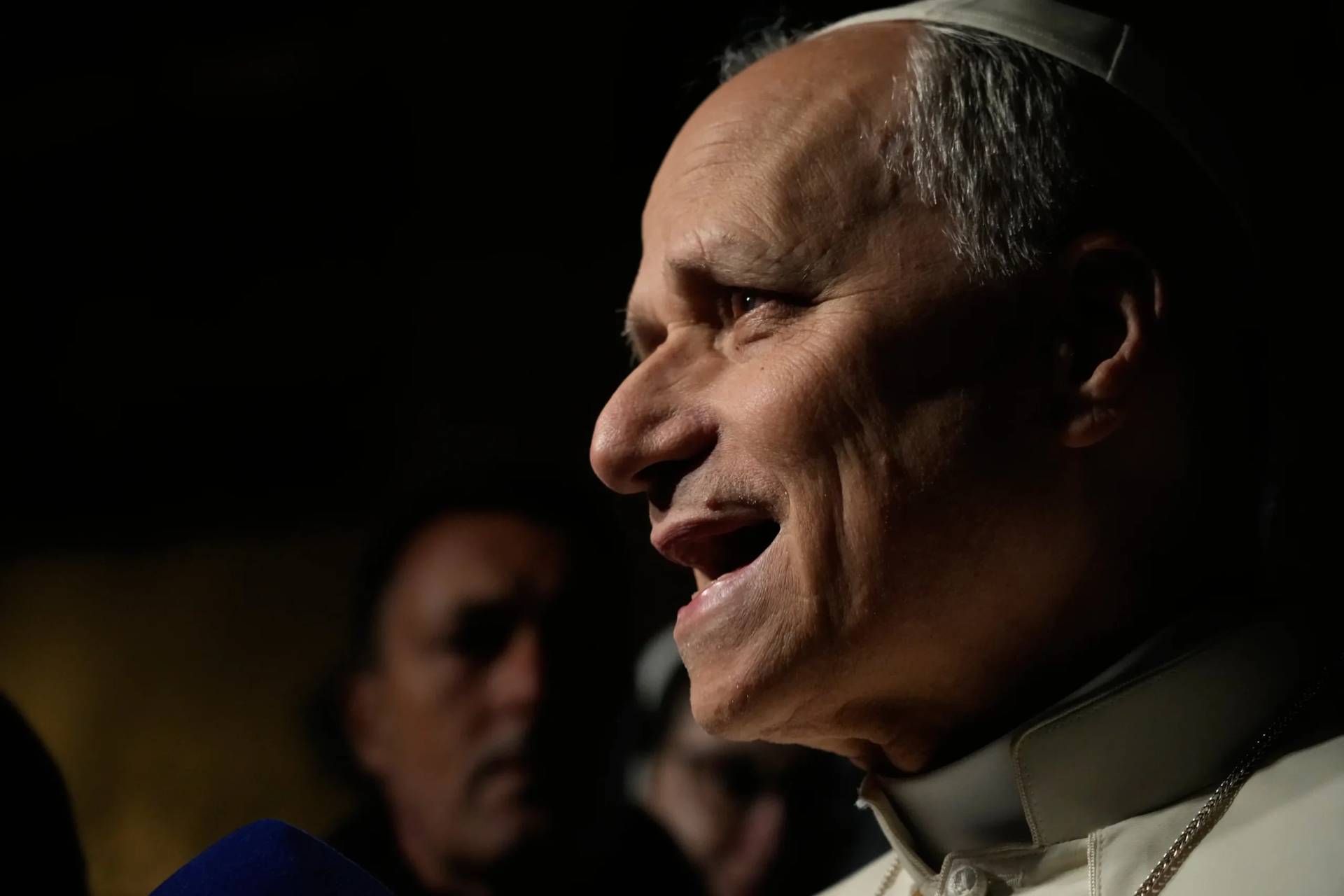
Pope Leo XIV met with clergy and religious of Naples on Friday afternoon, and with the citizenry of the sprawling southern metropolis, praising the city and encouraging its people while warning against spiritual neglect and civic apathy, calling clergy and people alike to foster strong community in the best traditions of their city and their faith.
The meetings were part of a pastoral visit to southern Italy on the day of his anniversary – the first of his election to the papacy – that began Friday morning in Pompeii, in the footsteps of Saint Bartolo Longo.
Longo, a compelling character of Italy’s nineteenth century, returned to the faith after practicing Satanism in his youth.
He became a champion of charity, catechesis, and devotion to the Blessed Virgin all throughout the Valley of Pompeii from his conversion in 1871 until his death in 1926, aged 85.
“Naples is a city of a thousand colors,” Leo said in his afternoon remarks to clergy and religious in that city, “where the culture and traditions of the past blend with modernity and innovation.”
The pontiff said Naples – Italy’s third city, after Rome and Milan, with a population of 3 million and a history that stretches far into the first millennium BC – is a city with “a spontaneous and effervescent popular religiosity interwoven with numerous social fragilities and the many faces of poverty.”
An ancient city in constant movement
“It is an ancient city yet in constant movement,” Leo said, “inhabited by much beauty and at the same time marked by much suffering and even bloodied by violence,” a reference not only to persistent poverty but also to the powerful presence of organized crime.
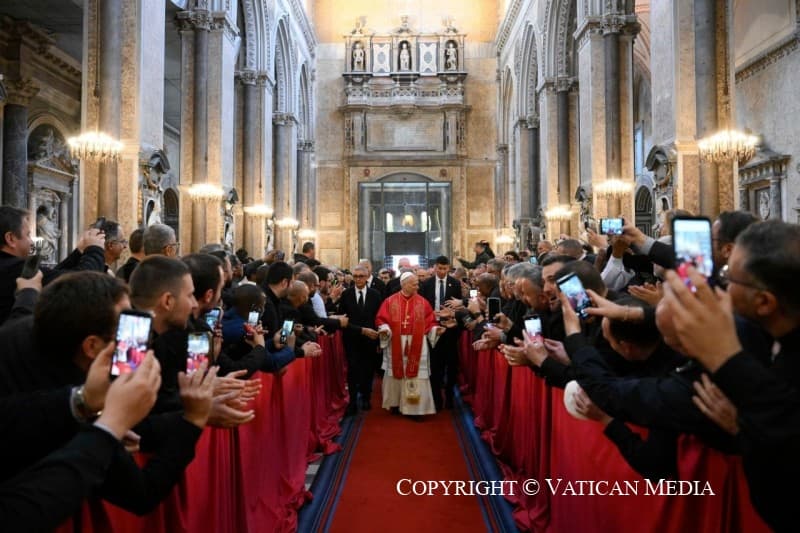
The appointment with clergy and religious was the first of the afternoon and took place in the Neapolitan Cathedral of the Assumption of Mary, where the pope also displayed the relic of the city’s patron, the blood of St. Januarius — San Gennaro — sealed in an ampoule, which had liquefied ahead of the occasion, a phenomenon the Neapolitan faithful consider a sign of favor.
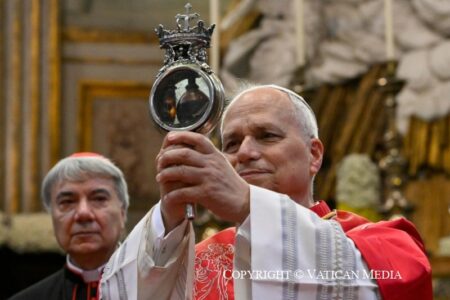
In remarks to the gathered clergy and religious, the pope focused on the theme of care – cura in Italian – taking inspiration from the story of the resurrected Jesus’ appearance to a pair of forlorn disciples on the road to Emmaus.
“Like those two disciples,” Leo said, “we too often continue on our journey, unable to interpret the signs of history.”
Leo noted how it is easy for clergy and religious to find themselves embittered and long-faced, “discouraged and disappointed by so many problems or by personal and pastoral hopes that seem unrealized.”
“Jesus,” he said, “nevertheless stands beside us and walks with us, accompanying us to open us to a new light: his is the attitude of one who cares.”
“The opposite of care is neglect,” Leo said, citing specific examples: “[T]he neglect of city streets and corners, common areas, suburbs, and, even more so, all those situations where life itself is neglected, when we struggle to preserve its beauty and dignity.”
It was with care of the interior life, however, that Leo was concerned in the first.
“Care,” he said, “for our hearts, our humanity, and our relationships.”
Leo offered his remarks “first and foremost to those in the Church who are called to a role of responsibility, to a service of governance, to a special consecration.”
“[T]he burden of ministry and the resulting inner struggle,” the pontiff said, “have become, in some ways, even more onerous today than in the past.”
New challenges
“Precisely because we are today more exposed to the effects of loneliness, living in a more complex and fragmented cultural environment,” Leo also said, “fraternity needs to be cultivated and promoted.”
Leo mentioned the possibility even of new forms of common life for priests to sustain and support one another.
“This involves not just participating in some meeting or event,” he said, “but working to overcome the temptation of individualism.”
“Let us think of ourselves as priests and religious together,” he said, encouraging the priests and religious to “practice the art of proximity.”
Leo also spoke of the recently concluded archdiocesan synod, which he praised as “a process that revitalized the entire ecclesial community, calling it to question its own way of being and proclaiming the Gospel in this land.”
The pope invited all in attendance “to preserve and embrace the Synod’s method,” which he described as “an exercise in mutual listening,” that engages everyone and excludes no one.
“[L]isten to one another,” Leo said, “walk together, create a symphony of charisms and ministries, and thus find ways to move from a pastoral ministry of conservation to a missionary ministry capable of intercepting people’s concrete lives.”
The pontiff – formed in the Order of Saint Augustine for which community is paramount – called the work he outlined “a mission that requires everyone’s contribution.”
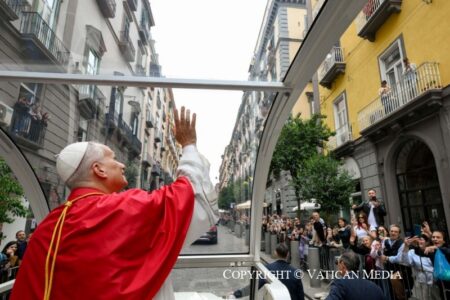
Leo explicitly cited inequality, youth unemployment, school dropouts, and family fragility among the many challenges facing Neapolitans. In such a context and environment, everyone suffers together and everyone has a role to play in the Church’s mission of solace and succor.
“[T]he proclamation of the Gospel cannot exist without a concrete and supportive presence that involves each and every one of us,” Leo said, “priests, religious, and lay people.”
“Everyone is an active participant in the pastoral care and life of the Church,” he said.
The Church and the City
These were themes to which Leo returned in his second appointment of the afternoon, with the people of the city and civic leaders in the city’s central Piazza del plebiscito.
“Brothers and sisters,” Leo said, “in this city flows a longing for life, justice, and goodness that cannot be overwhelmed by evil, discouragement, and resignation.”
“Therefore,” the pope said, “we must—not alone, but together—ask ourselves: what truly matters?”
“What is necessary and important to resume our journey with the impetus of commitment rather than the weariness of disinterest, with the courage of doing good rather than the fear of evil, with the healing of wounds rather than indifference?” he asked.
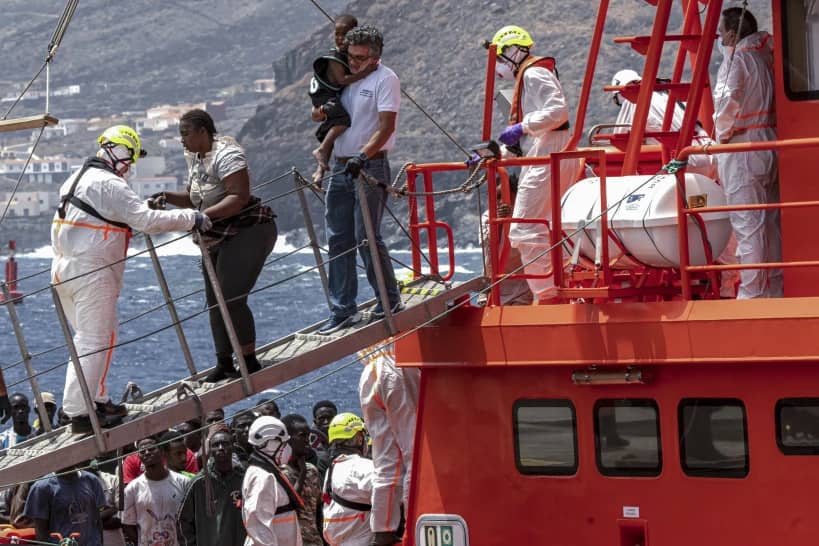
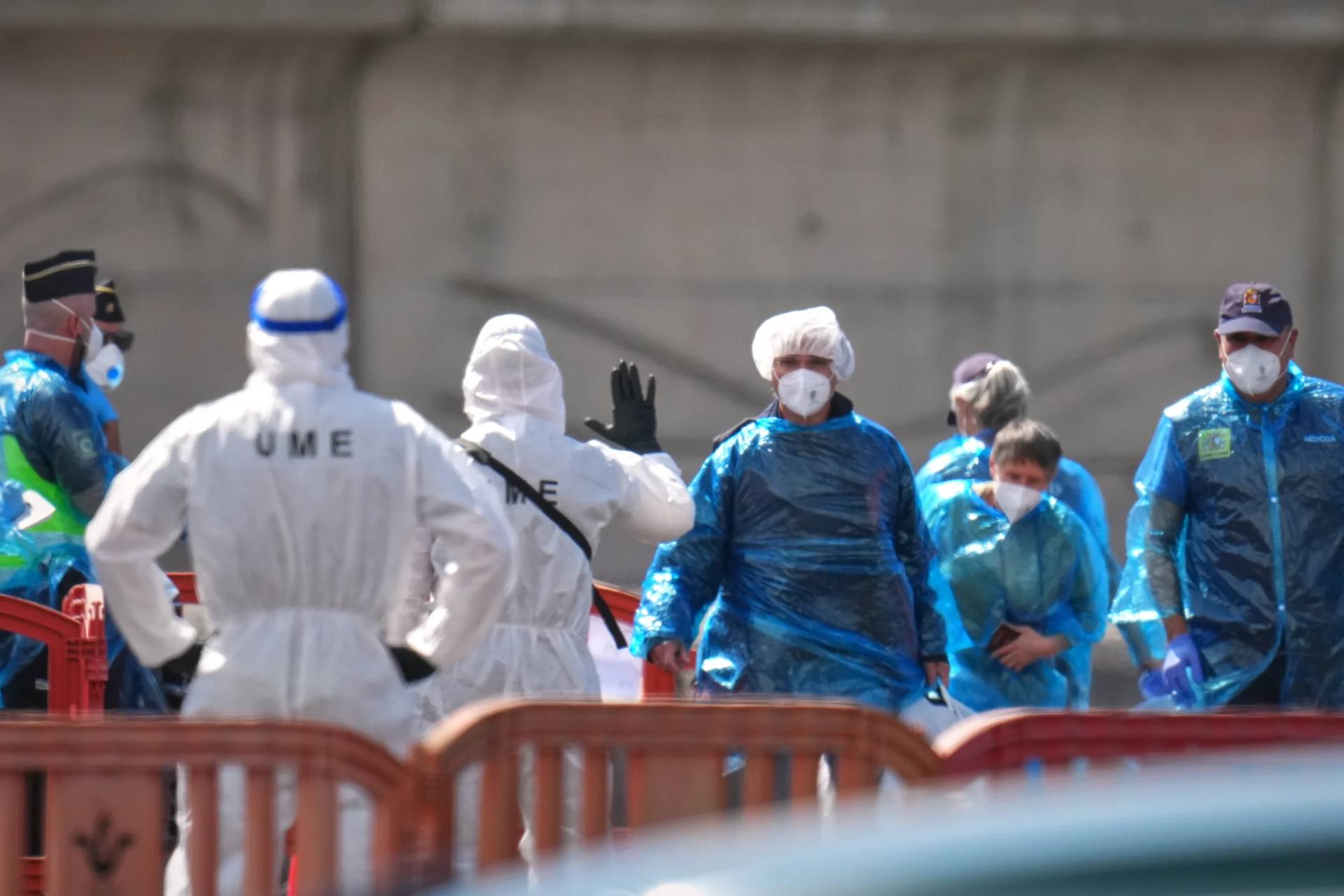
Leo praised the city and its people especially for their openness to migrants and refugees, of which the port city has welcomed and continues to receive many.
“Naples continues to reveal its deepest heart in welcoming migrants and refugees,” Leo said, “viewing them not as an emergency but as an opportunity for encounter and mutual enrichment.”
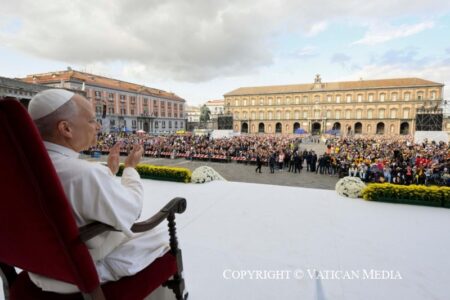
The pope noted the crucial contribution of the diocesan Caritas in this work, saying the Church’s charitable outreach “has also transformed the Port of Naples from a mere landing place to a living symbol of welcome, integration, and hope.”
“[T]ogether,” Leo said, “the ecclesial community and the civil community are working to make Naples a ‘platform’ for intercultural and interreligious dialogue.”
Leo also praised the many initiatives of the city’s people, among them conferences, international awards, and programs to welcome young people from conflict zones including Gaza, which the pope specifically mentioned.
The pope said Neapolitans may through these and other initiatives like them “continue to give voice, from the bottom up, to a culture of peace, countering the logic of confrontation and the use of force of arms as a supposed solution to conflicts.”
“Peace,” Leo said, “begins in the human heart, passes through relationships, takes root in neighborhoods and suburbs, and expands to embrace the entire city and the world.”
“This is why we feel it is urgent to work first within the city itself,” he said.
“Here,” the pontiff continued, “peace is built by promoting a culture alternative to violence, through daily gestures, educational programs, and practical choices for justice,” because “there is no peace without justice.”
“[J]ustice,” Leo said, “to be authentic, can never be separated from charity: developed, concrete signs of a peace that embraces hospitality, care, and the possibility of redemption.”
Follow Chris Altieri on X: @craltieri