
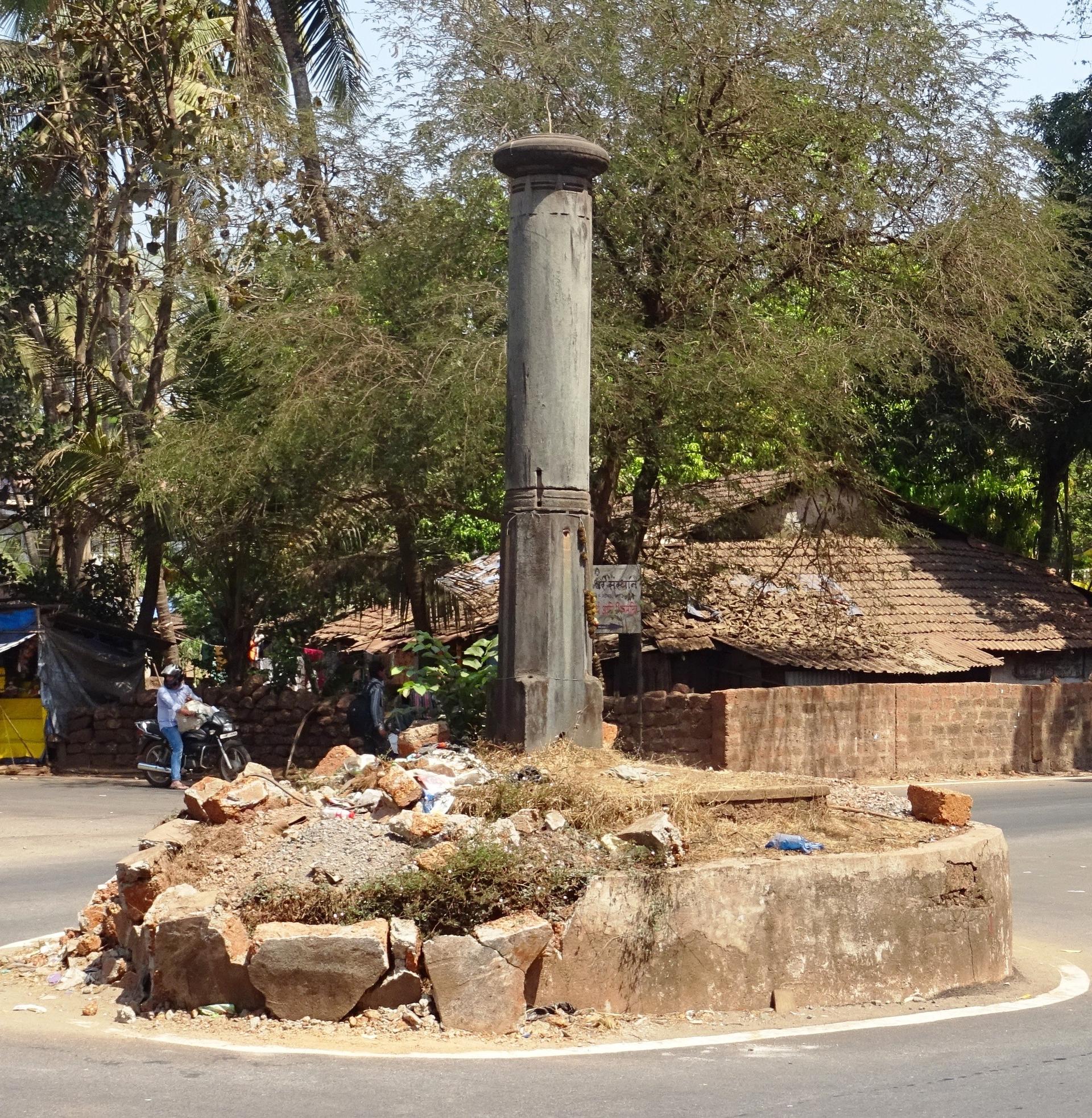
MUMBAI, India – There is a controversy over the 16th-century Pelourinho Novo (“New Pillory”) pillar in Old Goa after the Goa government recently referred to it as “Haath Katro Khambo” (Hand-Cutting Pillar).
It was a site where prisoners were punished during Portugal’s rule of the Goa region of India. The European country ruled the area from 1505 until 1961.
The move has reignited long-standing disagreements over its history, the available evidence, and political interpretations.
Today, some groups commonly refer to this structure as the “Hath Katro Khamb” or “Inquisition pillar,” and it has become part of a broader controversy over whether it should be officially recognized and renamed to symbolize alleged atrocities during the Goa Inquisition.
Right-wing Hindu organizations, including the Hindu Janajagruti Samiti (HJS), have previously held public events at the site, calling for its recognition as a memorial to victims of religious persecution. HJS maintains that the pillar is not merely a generic colonial-era structure but a direct symbol of the atrocities committed during the Goa Inquisition.
The state government’s move drew sharp criticism from historians, architects, and citizens, who accused the authorities of distorting history and legitimizing folklore associated with the Goa Inquisition.
The basalt pillar was erected during the Portuguese era and originally served as a civic marker. Archival records consistently describe the structure as a public monument, not a site of executions or mutilations.
Goa’s Directorate of Archaeology placed the pillar under its protection but adopted the Konkani name “Hath Katro Khamb.” The phrase, popular in local lore, suggests the pillar was used to sever hands as part of punishment, and some Hindu groups have long linked the site to alleged atrocities committed during the Inquisition.
According to The Goan, scholars insist there is no documentary or archival evidence to support such claims.
The controversy first spilled into the public domain over a fortnight ago, when a group of historians and professionals, including Dale Luis Menezes, Cedric Lobo, Joseph Marques, and Frazer Andrade, formally petitioned against the renaming.
They argue that institutionalizing the folkloric title elevates myth over fact and risks misleading future generations.
Frazer Andrade, a heritage enthusiast, formally objected to the department in a petition dated 6th April, challenging the notification of Hath Katro Khambo as a Protected monument under an incorrect name.
Critics warn that the change undermines historical accuracy and distorts Goa’s colonial past through sectarian narratives. It could mislead tourists about the State’s heritage.
Supporters, however, say “Hath Katro Khamb” acknowledges the brutality of the Inquisition and restores suppressed local memory. They argue that the change corrects historical neglect and promotes indigenous perspectives, according to The Goan.
Subhash Velingkar, convener of the Hindu Raksha Maha Aghadi, said the pillar should be shifted to a safe location in Old Goa and clearly identified as a relic of the Inquisition with a durable cement information board to make its historical significance visible to visitors, reported The Goan.
Crux Now asked Frazer Andrade about the origins of the Pillar and the colonial Portuguese history of this now controversial pillar.
Andrade: Colonial authorities were tasked with the essential duty of establishing a foundational set of structures when initiating a new settlement. This included the construction of a church, a city hall, a jail, and a pillory. Pelourinhos were typically positioned in a central public square adjacent to a civic building that served as the local seat of authority, where they became central to significant civic activities such as the administration of justice, public punishment, and the announcement of decrees or laws.
In Old Goa, the existing civic pelourinho is made from fragments of two stone pillars taken from a dismantled Hindu temple. The principal remaining Portuguese pillory, known as the Pelourinho Novo, is located at a vital urban intersection and plaza in the southern part of the old town, close to the main road that led south to Goa Velha, exiting the city’s defensive walls. The act of repurposing a sacred temple stambh pillar, which symbolizes the connection between heaven and earth for Hindus, to create a prominent emblem of Portuguese authority, serves as a powerful representation of religious and governmental dominance.
What are the the oral traditions of Hat Katro Khambo.
In the local Konkani language, the Pelourinho Novo has been referred to as the Hat Katro Khambo. The origin of this name may be traced back to an ancient pre-Portuguese practice in which minor offenders were publicly punished by amputating one of their hands.
This tradition likely began during the era of pre-Portuguese governance and continued throughout the period of Portuguese colonial rule. Similar practices are still observed in certain regressive societies, as evidenced during the Taliban’s rule in Afghanistan.
What is the history of the pillar?
The current pillory, which remains in its original location, is believed to date back to the late sixteenth or early seventeenth century.
The Pelourinho Novo is prominently featured on a late sixteenth-century map created by Jan Huygen van Linschoten, as well as on an early seventeenth-century map of Old Goa by Manuel Godinho de Erédia. This structure consists of two distinct sections of pillar, secured together with iron staples and fittings. The lower section is faceted and showcases decorative carvings that reflect an indigenous artistic style commonly found in stone columns of South Indian Hindu temples.
There is a strong indication that the pillar is of native Indian origin, likely sourced from a Brahman temple, although some uncertainties regarding its exact origin persist. An inscription on the lower part of the pillar, which reads “Dayadnya,” a term in ancient Kannada believed to refer to Lord Shiva, has led local historians to suggest that its elements originated from the Saptanath (Saptamatha?) temple on Divar Island, and is recognized as the only Shiva temple known to have existed in the Goa region during that period.
The Pelourinho Novo closely resembles the existing stambh columns located at temple ruins from the Vijayanagara Empire. This empire governed Goa during the fourteenth and fifteenth centuries, and its architectural style established a benchmark for Hindu temple construction throughout southern India in that era.
Incorporating a Hindu temple pillar, which serves as a symbol of war and conquest, into a public colonial government building conveys a remarkably potent symbolic message, further amplified by the structure’s prominent and central location.
It appears that the Portuguese rulers of colonial Goa intentionally and strategically employed this symbol, maintaining its significance well into the twentieth century.
The “whipping post” or pillory significantly influenced the picaresque narrative of one Fernão Lopes, a former Portuguese prisoner who was conscripted to join Albuquerque’s initial expeditionary force.
After the initial defeat of the Adil Shahi forces at Ela in February 1510, soldiers who distinguished themselves in combat were rewarded with members of the Adil Shah’s harem. Historical accounts indicate that these soldiers became known as “casados,” a term that translates to “married” in Portuguese, and they faced considerable mockery and harassment for their relationships with women considered racially inferior. When clerics condemned these unions as immoral, the authorities began to arrest Bijapuri women and hand them to other men. Some of the casados, including Lopes, chose to defect to the nearby Muslim outpost at Banastarim, located on the opposite bank of the Mandovi, in order to stay with their wives.
Following Albuquerque’s counterattack in November 1510, Banastarim was taken into custody. The conditions of the Muslim surrender required them to deliver the Portuguese “traitors,” who were quickly put on trial and faced brutal punishments involving mutilation. About twenty “casados” were tied to pillories, where they suffered the loss of their noses, ears, right hands, and left thumbs. While half of them succumbed to their injuries, the survivors were eventually set free and expelled from Goa.
The pillar is believed to have originally stood near what is currently referred to as Gandhi Circle. It was later relocated to its present site due to the area’s congestion. The initial site of the pillar was known as Pelourinho Velho, which housed the ‘bazaar velho’ or old market. Additionally, the Pelourinho served as a venue for the proclamation of municipal decrees, making it a hub of significant activities and a representation of state authority.
Israeli Jews have shown considerable interest in the pillar. If it is indeed a remnant from the Inquisition era, as many suggest, it has undoubtedly borne witness to the tragic suffering endured by Jews during that period.
It is important to note that converted Jews, referred to as “Cristaos novos” or new Christians, along with native converts to Christianity, Black individuals, and heretics, faced severe persecution by the Inquisition tribunal. Among these groups, it is often said that converted Jews experienced the most intense suffering. Regardless of the pillar’s origins, it is more appropriately suited for display in a museum rather than being situated in the middle of a highway, where it is at risk of being involved in accidents due to its placement.
























![The Pelourinho Novo (lit. 'New Pillory'), also known as Hath Katro Khamb[b] (lit. 'Hand-Cutting Pillar'), in Old Goa. (Credit: Wikimedia.)](https://cruxnow.com/cdn-cgi/image/width=1920,quality=70/https://wp.cruxnow.com/wp-content/uploads/2026/04/pillar-in-india.jpg)