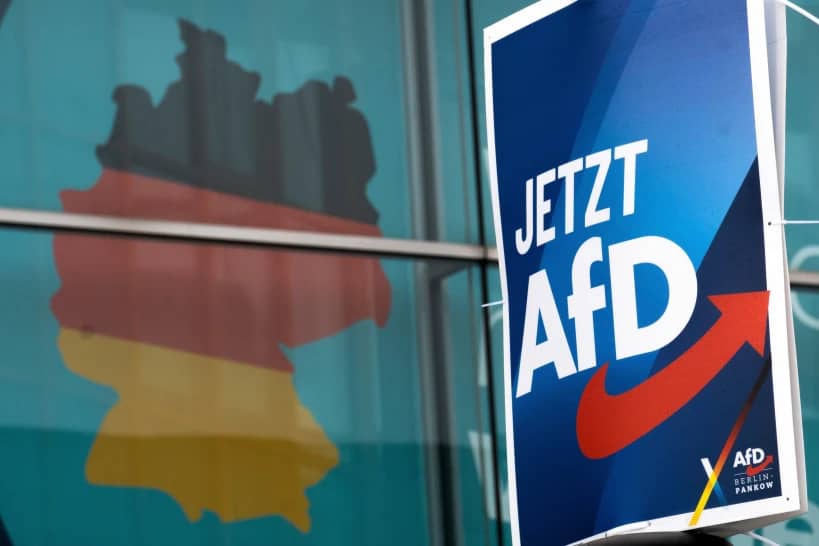
On Monday, the far-right party in Germany submitted a draft law that would stop some state payments to the country’s Christian churches.
The Alternative for Germany (AfD) introduced the bill against a backdrop of conflict between the far-right group and the German Christian establishment, with the Catholic bishops’ conference of the European country recently banning AfD members from working for the church, calling the party “unelectable.”
The Catholic and Protestant churches receive approximately €600 million ($707 million) annually on top of the billions in church tax they receive, and most of these payments are a result of Napoleon’s occupation of Germany at the start of the 19th century and his defeat of what was then the first German Reich.
Napoleon wanted the separation of church and state in Germany, and in 1803 there was a law that forced churches to hand over properties, land and money to neighbouring secular principalities.
They in return agreed to pay compensation which includes clergy salaries and other costs of churches.
In 1919, the Weimar Republic wanted these payments to stop with a one-off payment, which was enshrined in the constitution. In 1949, in postwar Germany the Basic Law incorporated this obligation into Article 140, and the payments have continued ever since.
“They are in tension with state neutrality and the modern understanding of religious freedom,” the bill says.
The AfD’s bill includes the establishment of a uniform procedure for evaluating and determining state payments and compensation amounts, and a definition of permissible forms of compensation, including one-off payments.
The previous coalition government led by Olaf Scholz, a Social Democrat, also proposed to end these payments but failed due to resistance from federal states.
The AfD’s election manifesto in Saxony-Anhalt, adopted over the weekend, also includes the desire to end state subsidies to public institutions, including the Catholic and protestant churches which it accuses of taking “left-wing positions.”
“Since the church tax churches no longer convey this message and have often distanced themselves from the Christian mission and are primarily active in socio-political matters, they cannot claim a special status through church tax collection and state subsidies,” the manifesto states.
The intention would be to make future state funding conditional. Polling suggests the AfD has a good chance of winning the state election for Saxony-Anhalt in September.
Church condemnation
AfD’s positions for the Saxony-Anhalt state elections came under fire from the region’s Christian churches, in particular the party’s desire to abolish the right to asylum and a political order that emphasizes national homogeneity and traditional gender roles.
“Human dignity, freedom, and solidarity find no place in this societal vision,” said a statement issued Saturday evening by the Catholic Diocese of Magdeburg, the Evangelical Church in Central Germany, and the Evangelical Church of Anhalt.
“Instead of shaping change with confidence, fear of change is being stoked,” the statement added.
In 2024, the German Catholic bishops’ conference released a statement that mentioned the AfD by name and said that ethnic nationalism was incompatible with Christianity.
“The AfD oscillates between genuine right-wing extremism, which the Office for the Protection of the Constitution attributes to some state associations and the party’s youth organization, and a right-wing populism that is less radical and fundamentalist,” the statement said.
“The dissemination of right-wing extremist slogans—which include, in particular, racism and antisemitism—is also incompatible with any full-time or volunteer service in the Church,” the bishops added.
To the bishops, “currently, right-wing extremism represents the greatest extremist threat to our country and to Europe.”
Cardinal Marx blasts Hegseth
Earlier this month, Cardinal Reinhard Marx, Archbishop of Munich and Freising, singled out U.S. Secretary of Defense for criticism during his Easter Sunday sermon.
He said Pete Hegseth was guilty of “shameless blasphemy” when Hegseth said he prayed that every American bullet might hit its target during the war with Iran.
In a sermon that criticized the use of religious language and imagery to justify war and conflict, Marx also denounced Patriarch Kirill I of Moscow for his statements on the war between Ukraine and Russia.