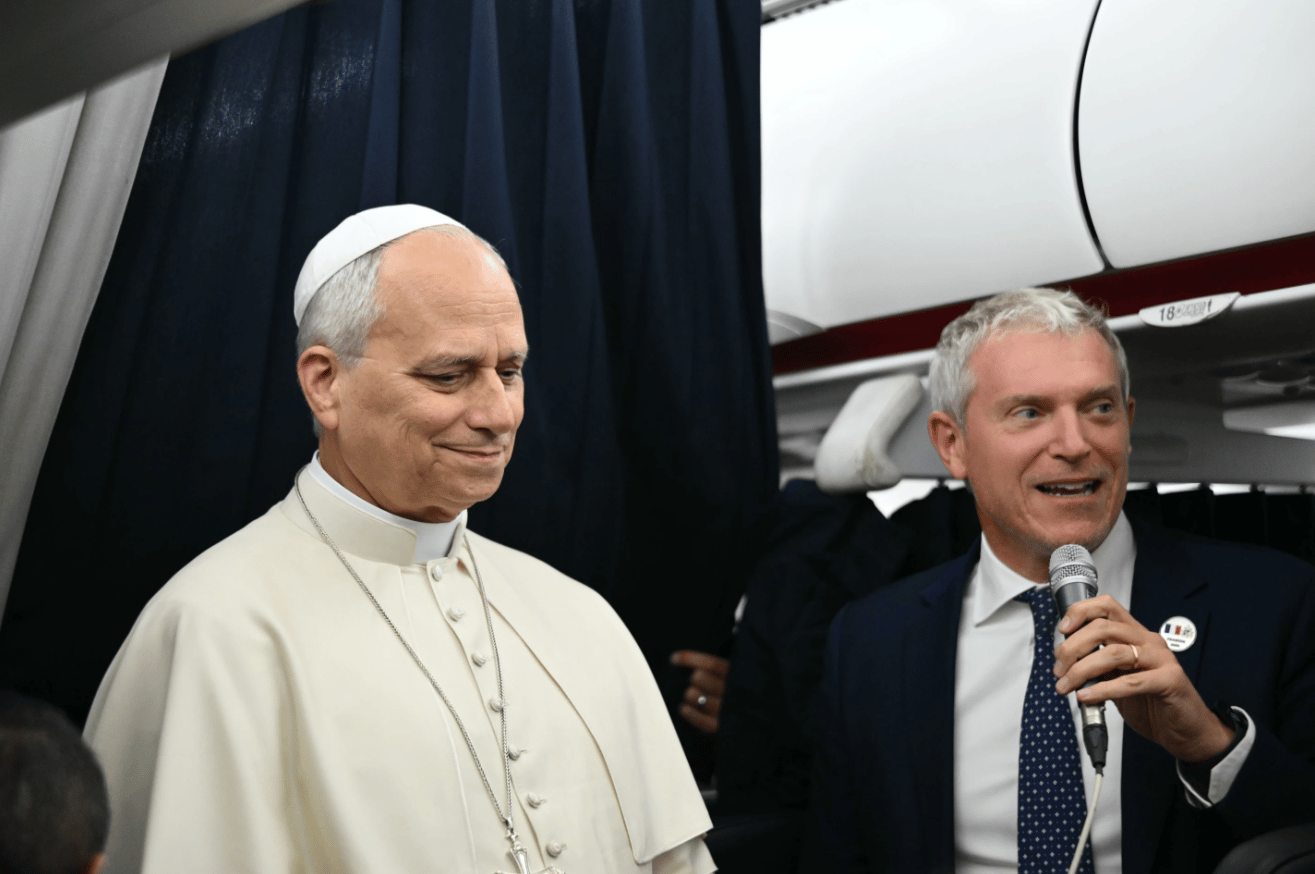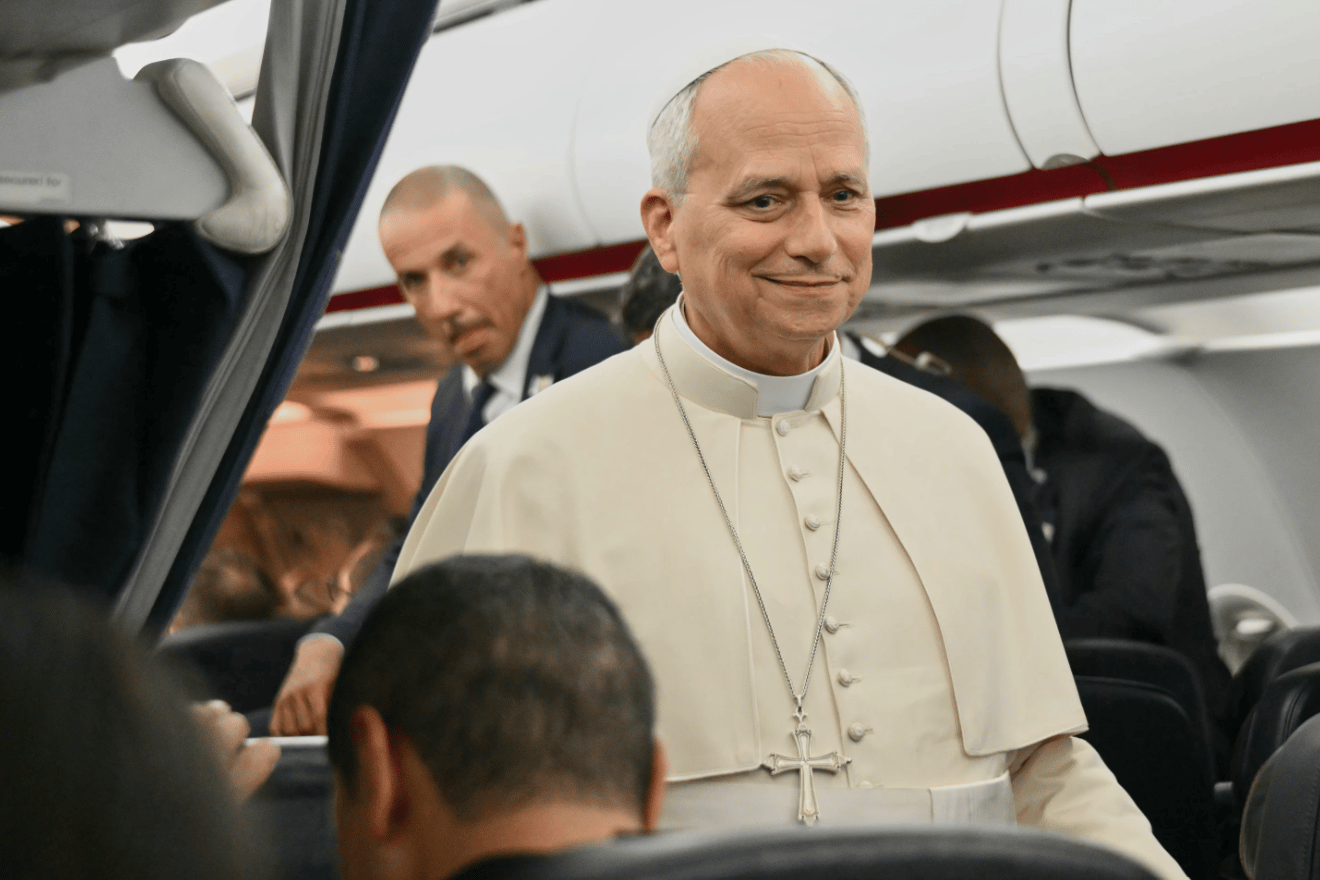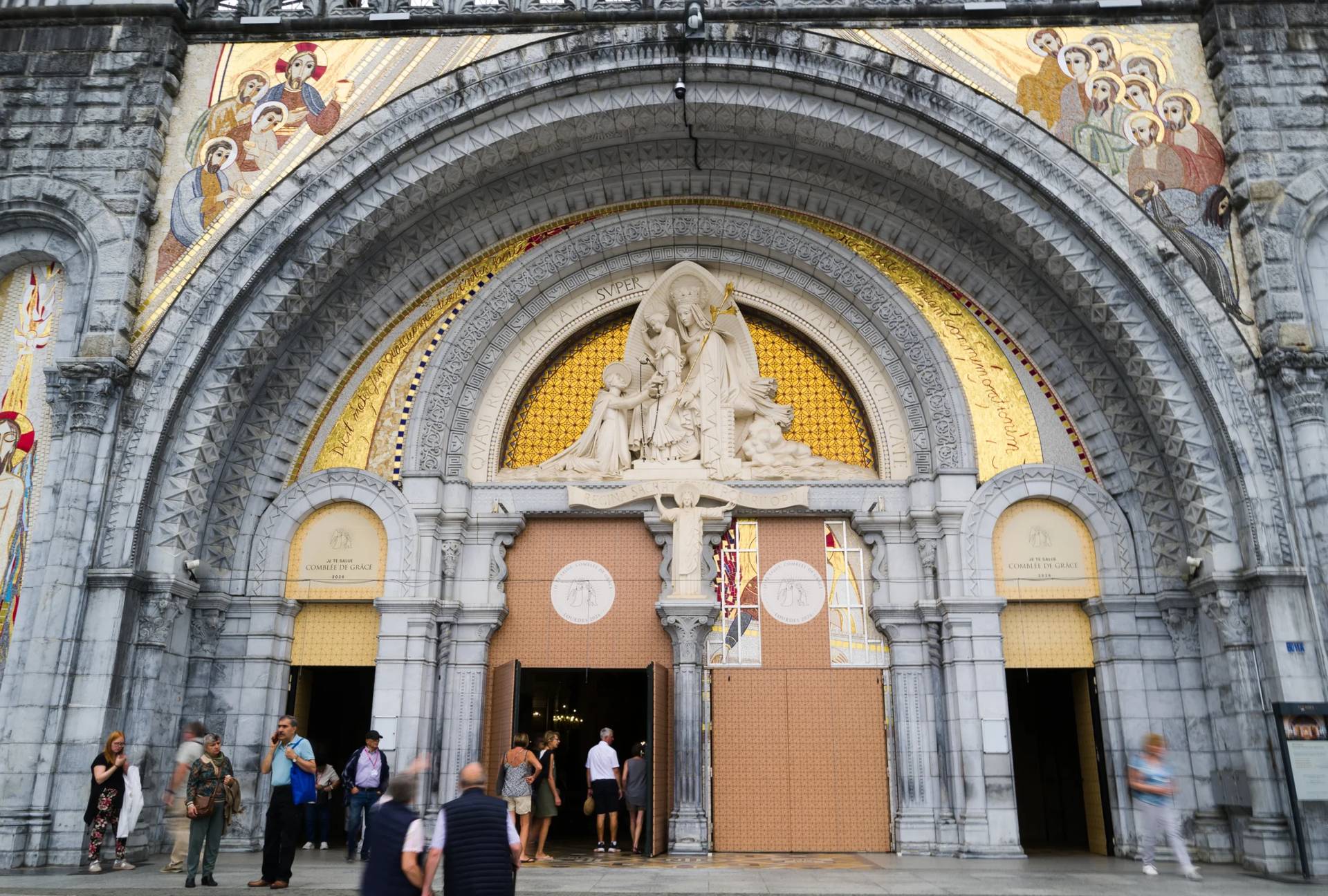
BARCELONA, Spain — On Monday, on the plane back to Rome from his visit to France, Pope Leo XIV called for fairer solutions as he offered his opinion on a story of an elderly, disabled woman in Spain who was evicted from her home on a stretcher.
The Maricarmen Abascal case has caused uproar in Spain, with the iconic Puerta del Sol in Madrid occupied by hundreds of tents from an encampment of people protesting against the housing crisis in the country.
Last week, Abascal was shown on TV being removed from her home of seven decades in Madrid on a stretcher and hospitalized, after her home was brought by a developer, Urbagestión.
However, news Tuesday broke that an agreement has been reached that she can stay in her home.
While admitting he didn’t know about the specifics of the case, Leo said there must be a search for “fairer solutions to prevent such cases from happening.”
He argued that the Church “as a community, as human beings, even for people who do not have faith, must seek fairer solutions to prevent such situations from occurring.”
“It seems to me that this would be a case where the neighbors, the community, the parish, the diocese, or the State would have to come forward and say, ‘How is it possible that such a case can happen? What is the problem in the system that allows an elderly woman, who is also disabled or has some difficulty, to be thrown out of her home?'” he said.
The Abascal case has shone a light on the cost-of-living and housing crises in Spain, particularly as Urbagestión first offered her the chance to buy her flat for €247,000 ($280,000) and then increased her rent €500 ($567) to €1,650 ($1,870) a month.
Abascal receives a state pension of €1,350 ($1,530) a month.
Leo said the housing crisis that exists in many countries is of such a scale that “a single parish, a single diocese, or the Church itself cannot solve it.”
“I believe there is a great challenge there, where we must perhaps also demand that political leaders and authorities find a solution,” he added.
Archbishop Luis Argüello of Valladolid, and president of the Spanish bishops’ conference, took to social media on Monday to offer his opinion on the case.
“Three types of evictions are currently making headlines: from housing, from Ceuta, and from the maternal womb. All three call for calm dialogue and agreements,” he wrote on X (formerly Twitter).
“Thus, we find ourselves facing a fourth eviction: Reason and the will to reach agreements seem to have been expelled from our common home,” he added.
Argüello also attached a statement, expanding on these ideas.
In it he said the case had become a “legal battleground and point of contention, ideological manipulation, and political and social conflict”. He called for a “social agreement” to be reached on the seriousness of the housing problem.
On the Ceuta crisis — when 60 thousand migrants crossed from Morocco into the autonomous peninsular Spanish city on the North African side of the Strait of Gibraltar, with many still remaining there — Argüello said the inhabitants were experiencing a situation of “eviction from their streets, squares, and their normal lives.”
He called for a national agreement to help the people of Ceuta.
He asked for a national and Europe-wide pact to tackle the root causes of migration, combat human trafficking networks, and reiterated that migrants be welcomed “with respect for their dignity.”
Finally, in reference to abortion, Argüello said that this “third eviction” caused “irreversible consequences.”
“All three issues demand calm dialogue and broad agreements,” Argüello concluded.
An agreement is reached
On Tuesday morning, news broke that an agreement between Abascal and Urbagestión had been reached, with the pensioner able to return home and continue paying “practically the same” as she has for the past few decades.
After a five-hour meeting between Urbagestión, Abascal’s lawyers, and representatives from the Municipal Housing and Land Company (EMVS), managed by the Madrid City Council, an agreement was struck, although Abascal needs to finalize it.
Her case has led to the “Maricarmen Decree” being proposed by the government, which was discussed Tuesday with other coalition partners.
Among the measures proposed are restrictions of evictions of tenants living in homes owned by investment funds and proposals to prevent investment funds buying more housing.
However, there is no guarantee it will be passed, with those on the far-left of Spanish parliament pledging to fight anything they consider watered down.
Further, part of the coalition governed by the Spanish Socialist Workers’ Party (PSOE) is right-wing pro-Catalan independence party Junts, who are likely to vote against anything that feels like too much of a concession to the left.
Therefore, PSOE and Sumar, a left-wing group launched in 2022 which holds 26 seats in parliament, have agreed to propose two decrees.
One decree is that which has been agreed between PSOE and Sumar, expected not to pass parliament, and the other agreed with Junts.
The vote is expected to be on Friday. Centre-right opposition People’s Party (PP) said it is “incomprehensible to vote” this Friday, denouncing the rush.
______
You are reading this Crux Now article for free. You can register for our free daily newsletter here, and you can become a Crux Now supporter for full access to all our premium content here. To find out more about why becoming a Crux Now supporter is a great idea, go here.