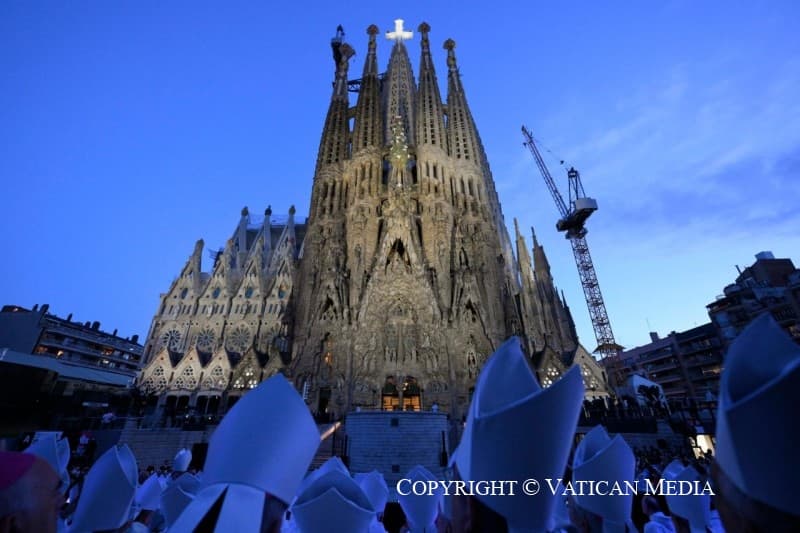
BARCELONA – On his second day in Barcelona, Pope Leo XIV blessed and inaugurated a recently completed tower on the city’s renowned Sagrada Familia basilica, which is now the tallest church in the world.
During the June 10 Mass and blessing, the pope called the Sagrada Familia “a visible sign of the invisible God, for whose glory its towers rise.”
By design, the papal visit and blessing ceremony coincided with the centenary of the death of the basilica’s celebrated architect Antoni Gaudí, whose cause for beatification is currently underway.
“Much more than a monument,” the pontiff said, “Basilica of the Sagrada Familia remains a work in progress today, reminding us that the Christian life is always a journey, because it is a project that God is carrying out.”
That the basilica is still incomplete “is not a flaw,” he said, rather “it bears witness to a desire” and promise “that we wish to honor with consistency” to continue building God’s kingdom on earth.
“Since we are the temple of the Holy Spirit, this work consists in our very lives, which God conceives as a masterpiece that we are to create together, and he calls us to collaborate with him,” he said.
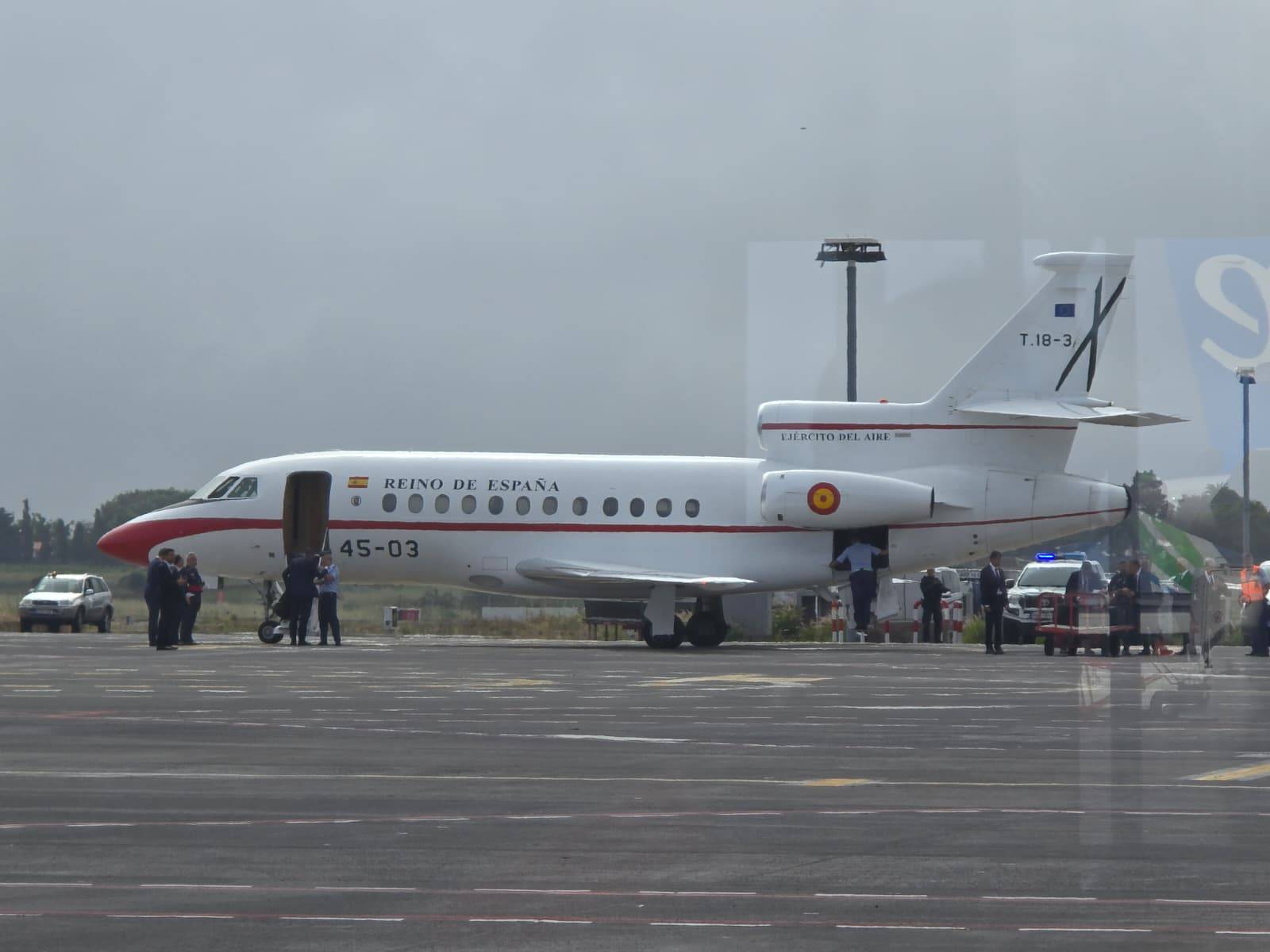
Leo is currently undertaking a June 6-12 tour of Spain that began in Madrid and will also take him to the Canary Islands to reinforce his support of migrants seeking entry into Europe.
After Wednesday’s Mass, the pope blessed the basilica’s new tower of Jesus Christ, completed earlier this year, and which was lit for the first time after its June 10 inauguration. A firework display was then held for attendees.
Leo celebrated Mass after a packed day in Barcelona that had him visiting the city’s Brians 1 prison complex and traveling to the famed mountainside abbey of Our Lady of Monserrat, where he prayed the rosary and had lunch with the Benedictine community overseeing the property.
He then held a meeting with diocesan charity and welfare organizations before celebrating Mass and inaugurating the tower of the Sagrada Familia.
In attendance at the Mass were Josep Rull, President of the Parliament of Catalonia; Salvador Illa, President of the Government of Catalonia; Pedro Sánchez, Prime Minister of Spain; and King Felipe VI and Queen Letizia of Spain.
According to Spanish newspaper La Vanguardia, Wednesday’s Mass marked the first time that Sánchez has attended a religious celebration since he took office eight years ago.
In addition to the political leaders present, some 250 bishops from across Spain were expected to attend the Mass, and an estimated 8,000 seats were prepared, half inside the basilica, and half outside.
Pope Benedict XVI consecrated the basilica for public worship in 2010, designating it a minor basilica, marking the first time that religious services and visitors were allowed inside the structure.
The Sagrada Familia and ‘God’s Architect’
With the completion of the Tower of Jesus Christ 144 years after construction initially began, moving the completion of the landmark into its final stages, the Sagrada Familia has become the tallest church in the world, standing at 566 feet tall.
The inauguration of the Tower of Jesus Christ coincided with the exact centenary of the death of its renowned architect, Antoni Gaudí.
Born in Spain’s autonomous Catalonia region in 1852, Gaudí was given the colloquial title of “God’s architect” after his death due to his deep piety, the dense religious symbolism in his work, and the stunning work of the Sagrada Familia, known throughout the world.
He was raised as a pious Catholic and is among the most celebrated of Spain’s architects in the last two centuries, with many of his designs thick with references to nature.
Work on the Sagrada Familia began in 1883 and became so all-consuming that in 1914 Gaudí dropped all other projects to dedicate himself exclusively to what has become Spain’s iconic masterpiece. The basilica was his sole focus until his death.
Gaudí died after being hit by a tram June 7, 1926, during his daily walk to the Sant Philip Neri church for his habitual prayer and confession. Passersby assumed he was a beggar and did not immediately call for help. He was eventually transferred by taxi to a hospital where he received basic care.
By the time the chaplain of the Sagrada Familia recognized him the following day, his condition had already deteriorated too severely for additional treatment, and he died June 10 at the age of 73.
Gaudi’s beatification cause is overseen by the Association for the Beatification of Antoni Gaudí, initially launched as a small group of laymen with a modest budget in 2003.
Originally built in the center of Barcelona because it was cheaper than other areas, the Sagrada Familia is nearly the same distance from the mountains, the sea and from Barcelona’s two rivers.
The Sagrada Familia draws millions of visitors each year and and over the years has been credited with several conversions to Catholicism.
Gaudí’s tomb is located in the basilica’s crypt, which Pope Leo visited prior to celebrating Mass Wednesday evening.
The tower Leo inaugurated Wednesday is laden with symbolic imagery on both the outside and the inside, with the 12 sections of stone paneling forming the main section of the tower adorned with mosaic palms and ceramic tiles.
Inside the tower is a spiral staircase and elevator to the base of the towering cross atop the tower. A second flight of stairs runs up to the pinnacle of the tower, into the cross itself.
The walls inside of the main section depict the heavens, containing over 10,700 square feet of colored ceramic tiles. Suspended from the upper arm is a stained-glass depiction of the Angus Dei by artist Andrea Mastrovito, surrounded by golden rays.
The ends of the four main arms of the cross are decorated with reliefs of scenes from the life of Jesus Christ, with the city of Barcelona visible through the windows inside of the cross.
The catechesis of the Sagrada Familia
Cardinal Juan José Omella y Omella, archbishop of Barcelona, acknowledged in greeting Leo at the Mass that the world is experiencing “difficult times,” but said that in the midst of contemporary challenges, Christians “do not want to be harbingers of doom, but rather sowers of hope.”
“The Sagrada Familia and the tower of Jesus Christ that you are going to bless encourages us to lift up our gaze toward the light that is projected by this tower, which culminates in the cross of Christ,” Omella said.
Omella said Gaudí’s witness to life and his impressive work “spurs us to move forward without becoming discouraged, putting Jesus Christ at the center of our lives.”
In his homily, Pope Leo said that despite the impressive designs of the Sagrada Familia and the inspiration it offers as a place of worship, it is not man who makes a dwelling for God, it is God who gives a place and home to humanity.
“The place he gives us is his own heart: the place of the Son, for us who were strangers; the place of the Beloved, for us who are sinners,” he said.
Leo quoted Jesus in the Gospel telling the Pharisees that, “you will die in your sins unless you believe that I am he,” meaning the Messiah.
“These are strong words, which are by no means intended as threats or blackmail. They are an invitation to salvation – that is, a call to freedom extended by Christ, who desires for us the ultimate, eternal good,” he said.
When the world is faced evil, it can have the assurance that “the Lord is always with us, always on our side,” he said.
The pope condemned all forms of violence against human life and dignity, saying, “we cannot believe in Jesus and promote war.”
“We cannot believe in Jesus and kill the innocent. We cannot believe in Jesus and abandon those who suffer, those who weep, those who flee from misery,” a line that powerfully pointed both to the plight of migrants and to current efforts by the Spain’s Sánchez-led governing coalition to enshrine abortion as a constitutional right.
He pointed to the three facades of the Sagrada Familia recounting Jesus’s life and the story of salvation, saying they bear witness to the fact that through Jesus, the dead will rise again, and sinners can become saints.
The tower of Jesus, he said, requires humanity to “lift our gaze toward him, toward the one who alone reveals to us the truth about God and the truth about ourselves.”
In looking to Christ, it is possible to see the world in a new way, and the tower atop the basilica, he said, becomes a symbol of charity, “for God loves us in this way, transforming an instrument of death into a sign of hope.”
Faith, he said, is what has shaped the construction of the Sagrada Familia from the beginning, and it continues to give meaning to the basilica as a place where people gather in worship.
God, the pope said, “is the artist who has imprinted his splendor upon the cosmos.”
“Created in his image, humanity responds to God’s work with its own ingenuity: this is how the artist transforms talent into praise and creativity into a testimony to the creator himself,” he said.
Pointing to Gaudí, Leo said that as an architect inspired by faith whose designs narrate the various mysteries of Jesus’s life, Gaudí takes visitors on “a spiritual pilgrimage, leading to an encounter with Christ who for our sake was born, died and rose again.”
Leo thanked the supporters and benefactors of the basilica’s construction, calling the work “an eloquent catechesis made of stones, colors and light.”
Cathedrals and basilicas themselves are often “rich messages of evangelization,” he said, saying, “In this age in which image is so prevalent, it becomes even more evident how art and beauty are privileged channels of evangelization.”
Follow Elise Ann Allen on X: @eliseannallen