The recent discovery of at least 172 bodies in mass graves near Uvira has shattered the fragile illusion of stability in the Eastern Democratic Republic of Congo.
Bishop Sébastien-Joseph Muyengo Mulombe of Uvira describes the recent calm not as peace, but as a deceptive “graveyard peace,” where violence operates silently and populations are in danger of becoming desensitized to evil.
He also issues a blistering critique of the international response, warning that a proposed American “minerals for peace” agreement is a “trap” that risks exchanging the country’s sovereignty and resources for a false stability.
Following are excerpts of the interview, edited for length.
Crux Now: The discovery of more than 170 bodies in mass graves near Uvira is a shocking testament to the brutality of recent events. Can you describe the current atmosphere in Uvira and the surrounding villages?
Muyengo Mulombe: We were all shocked to discover this sad reality, especially since we had spent 40 days in peace with the M23/AFC. We called it a “graveyard peace,” knowing our brothers somewhat from experience. You speak of a mass grave with 170 bodies, but in reality, it was two graves containing a total of 172 bodies, as the Governor of South Kivu informed us during a MONUSCO visit. We wouldn’t be surprised to uncover other secrets if true peace were to return.
This is typical of our brothers’ methods; they operate subtly and silently, like a night mouse that scratches you while breathing on your body to lull you to sleep.
I wonder what similar things we will discover in all these occupied areas once state authority is restored—if that isn’t just a pipe dream. The population lives in an atmosphere of desolation, beginning to get used to this kind of tragedy. That is the danger: when one begins to get used to evil, one trivializes it.
Local authorities and civil society organizations have accused the M23 rebels of these murders, targeting civilians suspected of supporting the army. How does this cycle of accusations and reprisals destroy the social fabric of your society?
To our knowledge, the victims weren’t just civilians suspected of supporting the army, but also young people who refused forced recruitment, family members who resisted letting their children go, and witnesses to these operations.
There is no better way to destroy the social fabric. Imagine the trauma this creates. As Pope Francis asked in his memoir: Che cosa lascia una guerra? What does a war leave behind? In general, the seeds for new conflicts, more violence, more mistakes and horrors, revenge, etc.
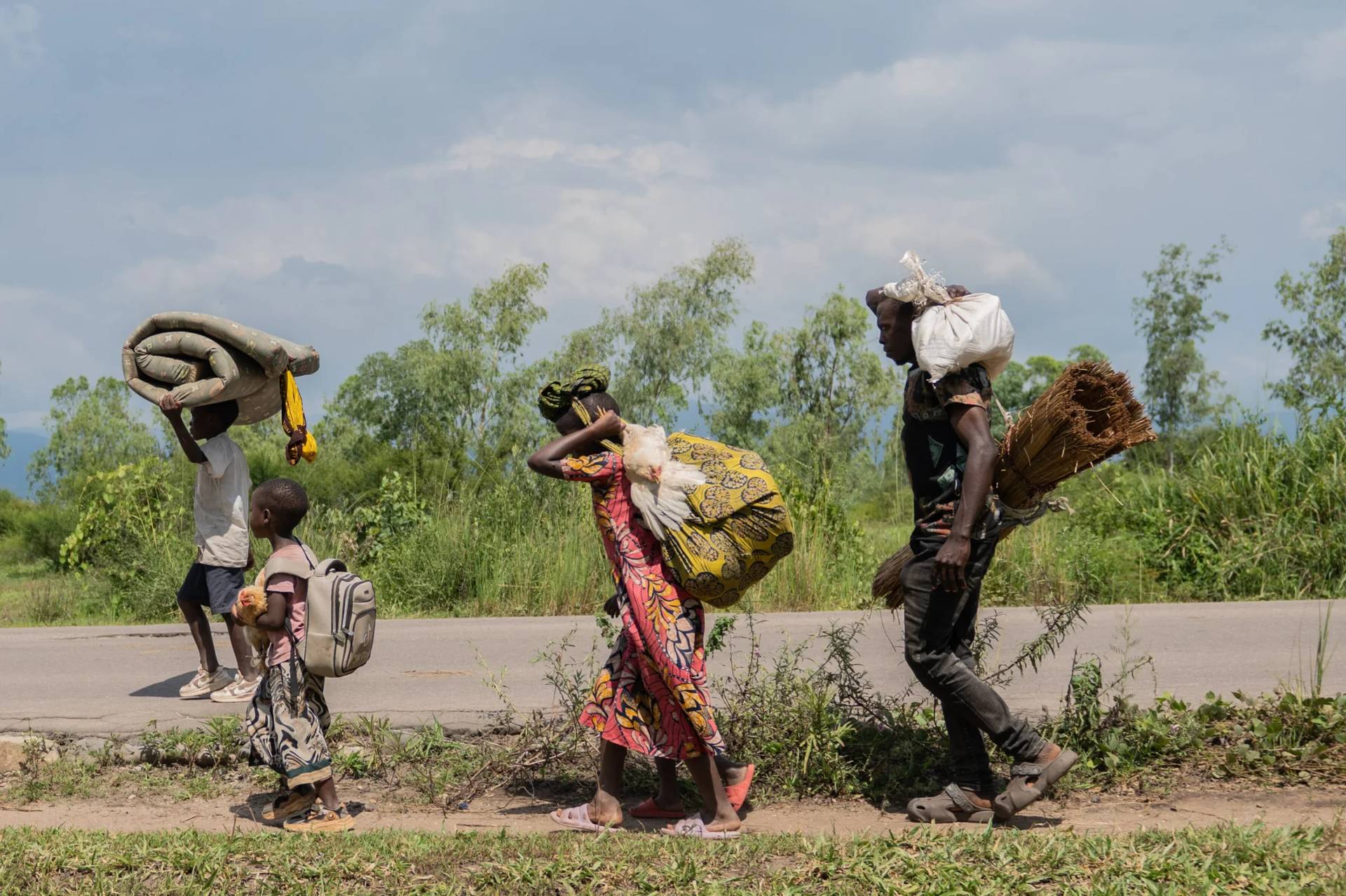
The UN reports that 200,000 people have fled the recent fighting, many crossing into Burundi. What is the Church doing to provide material, spiritual, and psychological support to these families?
While the UN speaks of 200,000 people, UNICEF gives the figure of 500,000 displaced to Burundi, Tanzania, and within the region. But it is not the statistics that matter; where even a single person suffers unjustly, that should concern us. News reaches us about the appalling conditions in which Congolese people are living — crammed into refugee camps, stadiums, and open spaces, exposed to the rainy season without blankets, food, or medicine. This has led to a surge in deadly diseases. We are talking about nearly 10 to 30 deaths per day in these camps.
The dire security situation makes it difficult for us to cross the border to offer spiritual and material assistance. Nevertheless, through Congolese citizens living in Burundi, we are trying to help with food and medicine. We are taking steps to get authorities on both sides to allow those who wish to return home to do so.
Many are afraid to return, yet others are desperately trying to flee the camps but are outraged that they are not being allowed to leave. When the border was opened for 48 hours in December 2024, it was done without problems for Burundians living in the DRC, but not for our own citizens. All this illustrates how complex the insecurity is here.
How do you preach forgiveness and peace when people are still discovering the bodies of their loved ones?
That is the crux of the problem: How can we preach reconciliation when people continue to kill each other? For over 13 years as titular bishop of Uvira, I’ve fought the temptation to give up. We must identify the root of the problem. The history of others should serve as our model. Consider Europe: after provoking two world wars, it vowed “never again.” To achieve this, they created unity around the economy, gradually moving from the Benelux to the EU.
This seems to be what we missed after our independence in Africa. We defined the “inviolability of territories” to guarantee sovereignty, but we failed to create large regional blocs where peoples divided by the Berlin Conference could live side by side as brothers. Later, organizations like ECOWAS or the EAC became difficult to manage because countries became isolated by jealousy over natural resources and the hegemonic dreams of their leaders. Meanwhile, groups within our nations felt like outsiders. Had we addressed this, allowing free movement across large areas, we might not be facing situations like those in Casamance in Senegal, Ambazonia in Cameroon, or the conflicts in Eastern DRC.
There are no deadlier conflicts than those based on land and power. And when a third factor is added—blood, or ethnicity — we reach a breaking point. Everyone becomes pagan; there is no room for reason or faith. People want to hear a gospel that flatters their ego, not one that denounces negative values. To this contradiction, there is only one remedy: “Repent, or you will all die” (Luke 13:3). Only conversion to peace, through justice and truth, can lead us out of this impasse.
In a conflict where armed groups, the national army, and international actors have interests at stake, what moral authority can the Church exercise? Have you been threatened for taking a stand?
The Church has no other authority to exercise than that of truth for justice and peace, with a preferential option for the poor—the voiceless and the powerless. As we witnessed with figures like Bishops Munzihirwa and Kataliko, when one embarks on this path, you will not be left in peace; you are accused of all the sins of Israel. In the DRC, everything divides us —the war, constitutional amendments, corruption, and kidnappings.
When you take a stand, some treat you harshly, labeling you corrupted by the Kinshasa regime or a member of M23/AFC, depending on the meaning of your words.
The UN has described this as one of the worst humanitarian crises in the world, but the violence persists. Why is the international community unable to put an end to it?
Let’s not be naive. If the UN can’t resolve the problem between Palestine and Israel, I struggle to imagine what it can do for the DRC other than empty pronouncements. The time has come to demand a profound reform of the UN, which has become obsolete. The Security Council, with its five permanent members holding veto power, is holding the world hostage more than 80 years after World War II.
There is talk of an American “minerals for peace” agreement, guaranteeing US access to Congo’s minerals in exchange for stability. From a moral standpoint, can this bring lasting peace, or does it risk creating a new form of exploitation?
At the risk of sounding like a pessimist, this is yet another trap. It is difficult to see how lasting peace depends on an agreement signed without analyzing the root causes of the crisis or gaining the approval of the Congolese people. By ceding our minerals to the Americans, I fear new wars will erupt in reaction.
Aiming only at his own interests (“America First”), I do not believe we should trust a man who says yes in the morning and no in the evening. Inconsistent and lacking pity, he represents a danger to world peace. Morally, by what right do we alienate these resources without thinking of future generations? As Pope Francis asks, “What kind of world will we leave to future generations?”
Is the Congolese government under pressure to accept an agreement that prioritizes American security interests over Congolese sovereignty?
What is certain is that our country will gain nothing from this Agreement; we are losing on all fronts. With the lack of governance, I don’t see what the people will get out of it. If any crumbs fall, they will end up in the mouths of our leaders—a blatant injustice. We are selling off our independence and sovereignty.
If you could speak directly to President Trump, the UN, and the heads of mining companies, what would be your most urgent appeal?
I would gladly put Pope Francis’s words in Kinshasa into my mouth: “Take your hands off the DRC, take your hands off Africa! Stop suffocating Africa: it is not a mine to be exploited or a land to be plundered.” But to President Trump, I would say: “Enough is enough!”
You may be the Master of the world, but you are not the god of the universe. Remove your hands from the world; other countries are not your stepping stones. Remember the wisdom: “Even enemies can respect one another.”