The interim report of an investigation into allegations of sexual abuse against a prominent post-war German cardinal is set to be published on Thursday.
Allegations against Cardinal Franz Hengsbach, the founding bishop of the diocese of Essen, first came to light in 2011 when a woman contacted the archdiocese of Paderborn to allege that Hengsbach, and his brother Paul, who was also a priest, had sexually abused her when she was 16 in Paderborn, in 1954.
Hengsbach died in 1991, but his brother was still alive at the time this allegation was made and denied it vigorously. Another allegation against Hengsbach’s brother was also made.
Church officials from Paderborn at first decided that the accusation against Hengsbach was implausible, but the archdiocese has now admitted that “the plausibility assessment at the time must unfortunately be seriously questioned” and has apologized to the woman.
The archdiocese reported the allegation to the Vatican in 2011, but the Vatican decided not to pursue the matter.
Bishop Franz-Josef Overbeckof Essen was also informed at the time.
“Due to the Congregation for the Doctrine of the Faith’s jurisdiction, I considered the matter to have been dealt with,” he explained at a later date, and apologized in a letter sent to the parishes of his diocese.
He admitted that he failed to report the allegation to the abuse team within his diocese, and also that he didn’t disclose the information to a research team that were investigating sexual abuse in the diocese of Essen.
That investigation found that Hengsbach didn’t deal with abuse cases properly, although offered no evidence to suggest he had committed sexual abuse himself.
In October 2022, further allegations against Hengsbach came to light when an alleged victim contacted the diocese of Essen to say Hengsbach had sexually assaulted them in 1967.
Overbeck made these allegations public in March 2023 and Essen and Paderborn asked other people to come forward if they had allegations.
Following this, in October 2024 researchers from the Munich-based Institute for Psychosocial Research, the Research Center for Contemporary History in Hamburg, and the Berlin-based Institute for Dissent, launched a study into these allegations, with the interim report set to be released this Thursday.
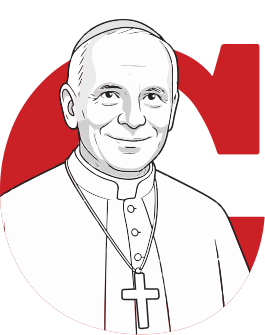
Cardinal Hengsbach
Hengsbach was a popular figure in postwar Germany and was the first bishop of the diocese of Essen which was founded in 1957.
He was known for outreach to Polish workers when he was a priest, even against the wishes of the Nazis when they were in power, and for his work supporting miners in the Ruhr region, referring to himself as the “miner’s bishop” and having coal set into his episcopal ring.
He often went down the mines with the workers and fought for their rights, clashing with Chancellors Konrad Adenauer and Ludwig Erhard.
“The Church must not stand by like a mute dog when it comes to people’s rights,” he said.
When he was enthroned as bishop of Essen in 1958, 15,000 people were there to greet him after the service.
Overbeck has admitted that Hengsbach’s reputation may have influenced his decision-making around the allegations.
“I also could not believe that a respected cardinal, who was also my predecessor as bishop, could have caused terrible suffering to other people,” Overbeck said.
Overbeck also said that he had been “prioritizing the protection of the reputation of a church dignitary and failing to give sufficient consideration to the people affected.”
A statue of Hengsbach outside Essen cathedral was taken down in 2023, shortly after the Church announced the investigation into the allegations against the cardinal.