SÃO PAULO, Brazil – As Haiti prepares to play in the FIFA World Cup for the first time since 1974, Brazilian missionaries in the Caribbean nation are planning to help local residents watch the matches – something that can be difficult for most Haitians, given that many have no access to electricity.
For both Brazilians and Haitians, soccer is not only a sport but also a major cultural force that fosters a sense of community and national identity. In Haiti, soccer is an omnipresent pastime for children, and many boys and girls dream of one day representing their national team – just as they do in Brazil.
While many Haitians are excited about the upcoming tournament, which begins on June 11, the catastrophic wave of violence and the lack of basic infrastructure throughout the country will certainly undermine the festive atmosphere that a World Cup typically brings to nations across the Caribbean and Latin America.
In May, a new surge in crime forced 300,000 people to flee their homes in Port-au-Prince. Clashes between rival armed groups intensified violence across several neighborhoods, causing numerous deaths.
Since the beginning of 2026, at least 2,310 people have been killed, 1,106 injured, 99 kidnapped, and 699 subjected to sexual violence.
The humanitarian situation is devastating. More than half of Haiti’s population requires humanitarian assistance, and about 5.8 million people face acute food insecurity.
The lack of access to basic sanitation is a harsh reality for millions of Haitians, and reliable electricity is equally scarce for most people.
“Our neighborhood doesn’t have access to electricity. That’s the case in all the poor neighborhoods of Port-au-Prince. Only the upscale neighborhoods in the hills have a few hours of electricity each day,” Brother Hélio Ferreira, a missionary with the Brazilian group Missão Belém (Mission Bethlehem), told Crux Now.
Ferreira’s organization runs schools and a nutrition center for children in need. It operates a kindergarten and a school that provide education and meals to 3,000 children and teenagers.
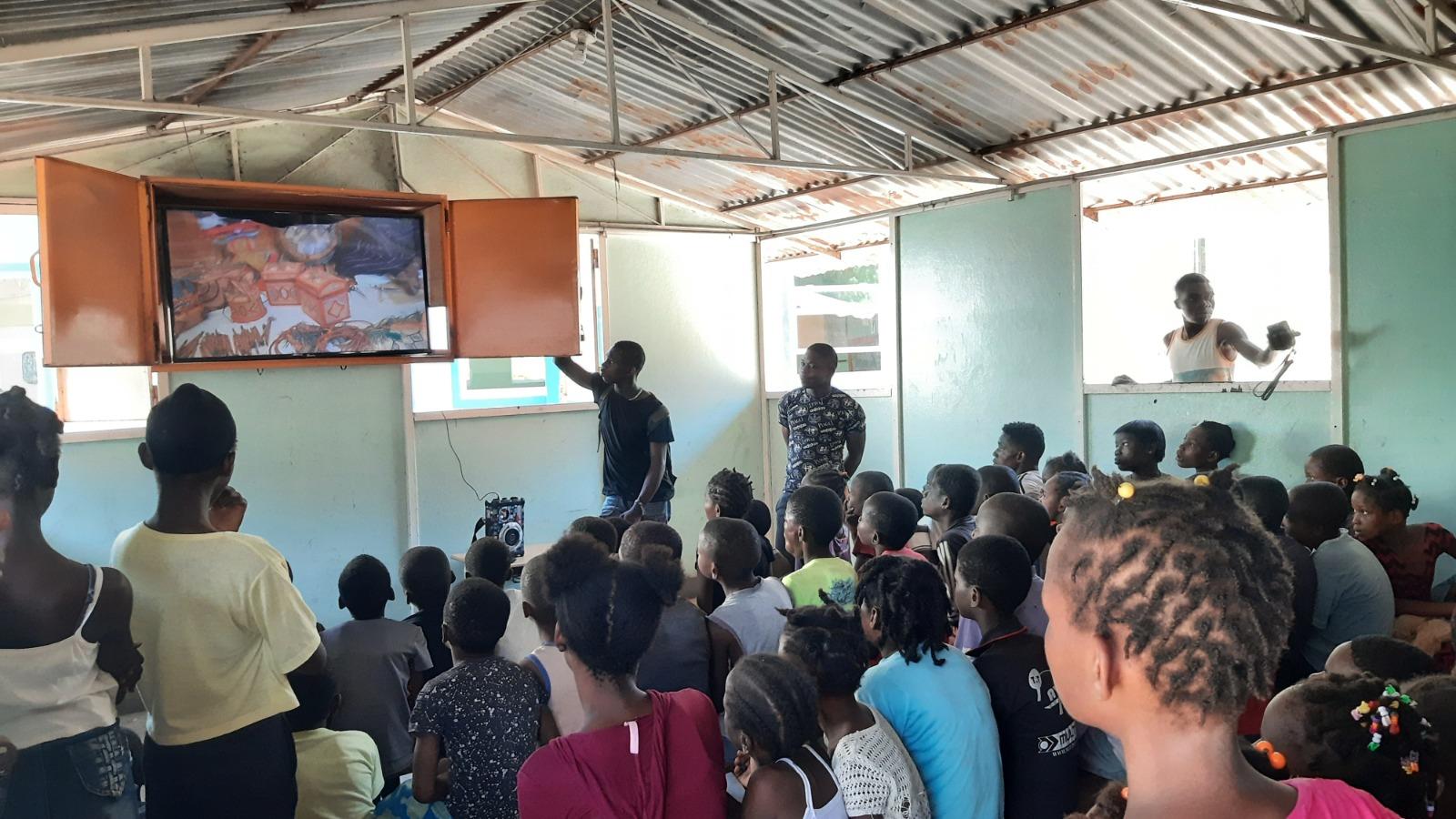
“We have a 40-inch TV and are planning to screen the matches for local residents. Our only concern is that some games will be broadcast in Haiti at night, which creates additional risks,” he said.
Without electricity, most people stay home after 6 p.m. and avoid going outside.
Brazilian-born Sister Helia Sange Moreira, a member of the Apostles of the Sacred Heart of Jesus, said Haitians are especially excited about their team’s participation in the World Cup after a 52-year absence.
“Despite all the difficulties they have been facing, they’re eager to follow the World Cup,” she told Crux Now.
Her congregation runs a school in a poor neighborhood with 270 students. Moreira said that during World Cups, the school usually sets up a large screen on the sports court and gathers all the children there.
“It’s like a festival. They forget about everything and just enjoy the moment,” she said.
If the match schedule does not allow the sisters to show the games at school, people will likely try to watch them at a local bar – possibly one with a power generator – or on their phones. Neither option guarantees uninterrupted viewing.
Of course, the school itself is not free from hardship. At the moment, for instance, it needs new school desks. But electricity there is more reliable than in many other areas.
Electricity is also a problem in Marin, on the outskirts of Port-au-Prince. Sister Maria de Fátima Alves said the entire district is without power.
“We work in an orphanage connected to a Camillian hospital. During World Cups, we usually invite the hospital staff to watch the matches together with the children,” she told Crux Now.
Alves and her colleagues care for 104 orphans with physical or mental conditions. The facility is full, so they recently had to divide it into two sections to better accommodate the children.
In fact, all the work carried out by Brazilian missionaries in Haiti has faced serious obstacles in recent years. The National Conference of Bishops of Brazil (CNBB) and the Conference of Religious of Brazil (CRB) launched an intercongregational mission called Nazaré (Nazareth) in 2010, following the devastating earthquake that struck Haiti.
As violence intensified in the Caribbean nation – particularly after the assassination of President Jovenel Moïse in 2021 – the risks became too great. In 2023, the mission’s headquarters were invaded and robbed, and Brazilian-born sisters were attacked and threatened.
The mission was eventually closed and replaced by a new project, this time without the support of the CRB and the CNBB. It has been led directly by a group of religious congregations, and the work has not been easy.
The Apostles of the Sacred Heart of Jesus have spent the past couple of years working in a parish in Trou du Nord, in northeastern Haiti. The sisters carry out educational activities for teenagers and assist the sick.
“We’re still a relatively new mission and have only a few missionaries working here. We do have electricity and a TV, but we don’t have an antenna, so we can’t tune in and watch the matches,” Sister Katiane Oliveira told Crux Now.
Brazil and Haiti are in the same World Cup group and will face each other on June 19 in Philadelphia. According to Hélio Ferreira, most Haitians traditionally support Brazil. This time, however, he is unsure what will happen.
“I’ll probably root for them and for us at the same time. Our hearts will be divided,” he said.