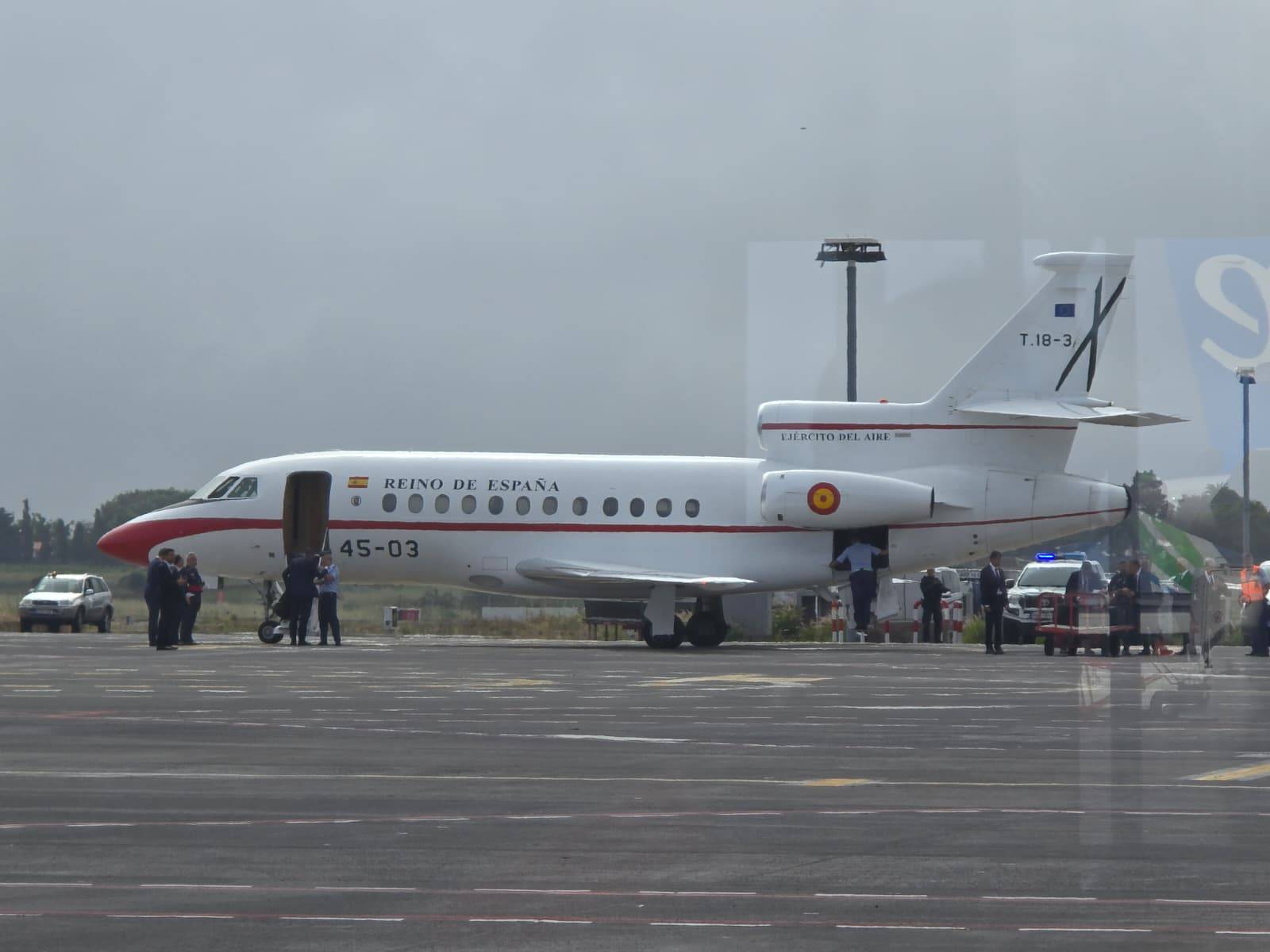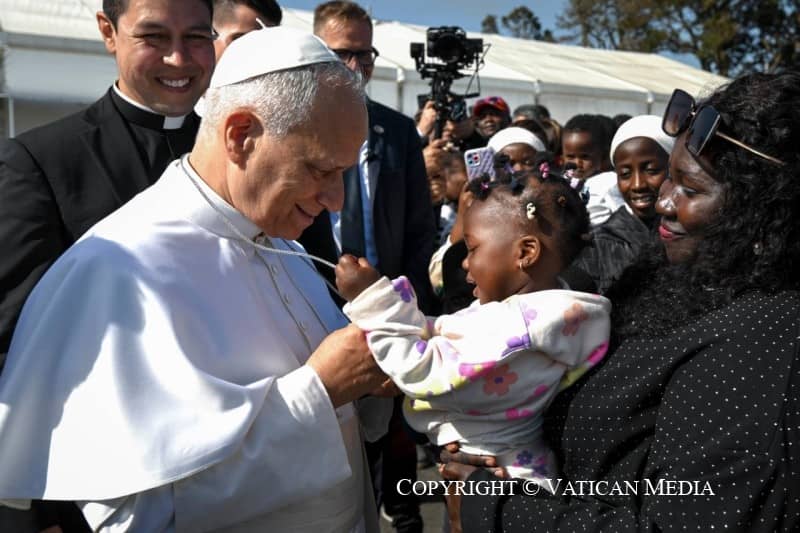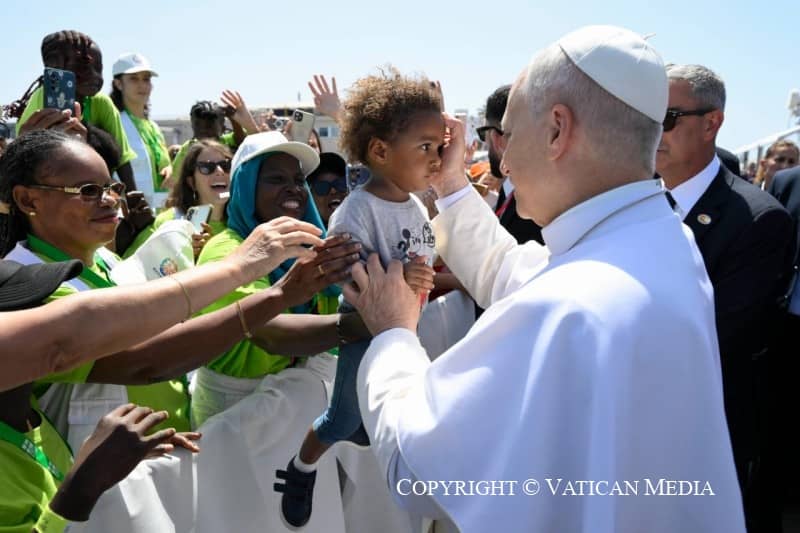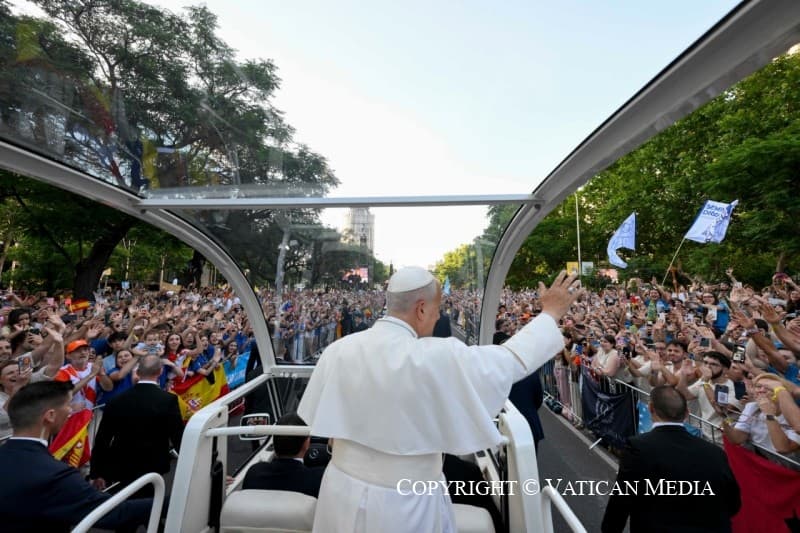
MADRID – Pope Leo XIV’s central message on his first day in Spain could easily be summed up with the commission he gave young people: “Be human.”
“Yes, be human: men and women of flesh and blood,” he said, calling on young people to be “not mere appearances, but trustworthy faces.”
Speaking to some 500,000 young people gathered for a prayer vigil in Madrid’s Plaza de Lima for the capstone of a packed first day in the Spanish capital, the pontiff called on them to be “people who seek justice because they hunger for it, as for their daily bread.”
He called on his young audience to be people who seek to live “an honest and upright life” and to be “missionaries of the Gospel amid the material and spiritual poverty of our time, knowing full well that our faith is a way of life that is lived out in charity.”
Throughout his formal events, Leo issued a clear call for Spain – and Europe more broadly – to put ideology and polarization aside and to put the human person at the center of their focus, through values such as solidarity and justice.
Leo will be in Spain June 6-12, traveling to Madrid, Barcelona, and the Canary Islands, and is expected to touch on issues such as migration, family and life issues, and pay homage to the Catholic roots of a rapidly secularizing nation that was once one of the world’s greatest evangelizers.
RELATED: In Spain, Leo XIV will reinforce Catholic roots amid rising secularism
Despite sparking a viral digital dispute en route to Madrid by declaring his loyalties in the country’s biggest soccer rivalry, Pope Leo carried his appeals against polarization and for social action rooted the Gospel throughout his Saturday appointments.
Speaking to civil authorities after paying a courtesy visit to Spanish monarchs King Felipe and Queen Letizia, he invoked Spain’s history of building a “culture of encounter, not confrontation” in light of modern global tensions, and called for everyone – across the spectrum of political opinion – to move beyond ideology and focus on the Gospel.
Address to civil authorities: Peace, solidarity, cooperation
“The message of peace, which at present unfortunately strikes some as naïve and others as confrontational, is welcomed by those who do not shut themselves off in preconceived ideologies, but are rather open to the truth,” he said.
This is ultimately what builds stability and prosperity in a nation, he said.
Referring to the global tendency toward violence, in action and emotions, he said this trend is often rooted in uncertainty and the loss of one’s grounding.
“This is why, even in public life, we need men and women who can perceive light in the darkness: a new beginning, like the dawn of a truth that as yet blinds us, but which – if we trust and find peace – will gently lead us toward itself,” he said.
In an age “shaken by terrible imbalances and conflicts,” he said there is a sense of searching for peace, understanding, and an attention toward human dignity capable of building “a civilization of love.”
Leo lamented that “the temptation to gain popularity by fanning the flames of polarization seems to have grown rather than diminished, and human dignity continues to be violated” in various forms.
This applies to not only the country’s tragic clerical abuse crisis, but also to strong anti-migrant sentiment in Spain and an ongoing push by lawmakers to advance legislation which, similar to what was previously done in France, would enshrine the right to abortion in the country’s constitution.
Facing such challenges, Leo said, “[W]e need culture, interiority, and free quality education; we need transcendence,” and invited all citizens “to set aside the divisive and polarizing narratives of your societal reality and history, so as to overcome sterile simplifications through the fruitful appreciation of complexity.”
He said his vision is “a vocation particularly suited to Europe, in which Spain plays a unique and fundamental role.”
Speaking to what his predecessor Pope Francis had once dubbed “Grandmother Europe,” Pope Leo said this ability to leave division and polarization behind is a gift that the “Old Continent” can offer to the world if it wishes to maintain its youth.
He alluded to the fears and political narratives that often accompany anti-migrant sentiment throughout Europe and beyond, which will be a focus of his visit to the Canary Islands at the close of his trip to Spain and of his July 4 visit to the Italian island of Lampedusa.
“Appreciating and studying complexity, learning not to deny it but to embrace it as a blessing, and fleeing from identity-based approaches that seem to explain everything yet only fill the world with ‘ghosts’ and enemies are the tasks of those who are heirs of a great history,” he said.
In a reference to the impact of new technologies on society, he stressed the need for a concerted investment in education, saying security, often placed in “weapons and walls,” is instead achieved through collaboration, “learning to move forward alongside one another, growing together, side by side.”
He also invoked Spain’s history of interreligious coexistence and dialogue with Islam and Judaism, saying the creation of space for conversation and dialogue that made these harmonious relations possible still mark Spanish society in modern times.
“This is the truth told by European cities: their historical stratification, the fabric of solidarity that has shaped their differences over the centuries, transforming inevitable conflicts into new beginnings,” he said, stressing also the need to choose “peace over arms and the saints to the powerful.”
“[A]void humiliating or antagonistic words,” the pontiff said, encouraging civil authorities rather to opt “for a clarity that sheds light and a frankness that unlocks new possibilities.”
RELATED: Leo XIV: A pope ‘of the heart’
“We cannot condone naïve enthusiasms, nor fuel unfounded fears,” he said, urging Spaniards to “establish standards for discernment,” and pointed to the basic principles of the Church’s social doctrine as a path forward in this regard.
He thanked Spain for the country’s “faithful adherence to international law and multilateralism, which is reflected in an active commitment to peace and solidarity among peoples,” and called on Spaniards “to harmonize the claims for autonomy and unity, and to advance the cause of unity in Europe – not in opposition to other powers, but as a gift to the entire human family.”
Closing his speech, the pope urged the nation to set an example for the European continent and to cultivate “dialogue and civic friendship within your own country, to take into account the perspectives of the poor and the young when envisioning the future.”
Solidarity and care for others: “Cedia 24 Horas”
Later Saturday afternoon, the pope highlighted the value of solidarity and care for others, stressing the need to begin with the poor and vulnerable in a visit to the “Cedia 24 Horas” project, a center in Madrid’s Lucero district dedicated to welcoming and accompanying the poor and homeless.
He underlined the importance of community and solidarity, saying, “By listening to one another, we face challenges together, without disregarding the complexity of situations and, at the same time, without neglecting the demands of charity and justice.”
The pope stressed the importance of society’s duty to those in need, calling it “a responsibility that consecrates every encounter with another as a kairós.”
He lamented that Christians too often “have succumbed to attitudes shaped by secular ideologies or political and economic approaches that lead to gross generalizations and mistaken conclusions.”
“The fact that some dismiss or ridicule charitable works, as if they were an obsession on the part of a few and not the burning heart of the Church’s mission, convinces me of the need to go back and re-read the Gospel, lest we risk replacing it with the wisdom of this world,” he said.
In the Gospel, he said, Jesus offers an invitation “to cultivate a heart that is sensitive to the needs of others,” and to safeguard the human person.
It is a call, he said, “to look those who suffer in the eye and to make our assistance, above all, an encounter between brothers and sisters united in the Father’s embrace.”
Meeting with young people: “Sparks of a new humanity”
Pope Leo XIV closed the day with his meeting with young people, responding to several questions about his own faith and sources of inspiration, as well as requests for advice on how to live as Christians in a secular and divided world, carrying through his urging to solidarity and faith as a means to overcoming division.
An increasingly confident Leo spoke off the cuff in fluent Spanish on several occasions in between reading his prepared remarks, at one point telling the young people not to be afraid of committing to marriage and forming families.
Referring to sources of inspiration for his own faith, the pope said one was Saint Toribius de Mogrovejo, a Spanish missionary in Peru known for his evangelization of indigenous cultures and studying local languages.
Leo, who will likely travel to Peru later this year to mark the 300th anniversary of Saint Toribius’s canonization, said the saint is an example of how to combine prayer and social action, and was especially attentive “to the abuses and corruption of his time.”
“For this reason, he is for me a model of dedication to the people, especially the poorest, in the name of Christ,” he said.
Advising young people on how to be Christians amid a rapidly growing wave of secularism in Spain and throughout Europe and the West, he urged them to stay rooted in the values of the Gospel.
He voiced hope that the those present would bear witness to Christ in the world, “including the realm of digital media,” and draw attention to the beauty of the faith in a culture that has forgotten it.
“In the face of the emptiness of indifference and compliance, before the violence of war and lies, you must be the sparks of a new humanity,” he said.
On Sunday, his second day in Madrid, Leo will celebrate Mass and have lunch with members of the Augustinian order before presiding over a meeting with the representatives from the worlds of culture, art, economy, and sport.
Follow Elise Ann Allen on X: @eliseannallen