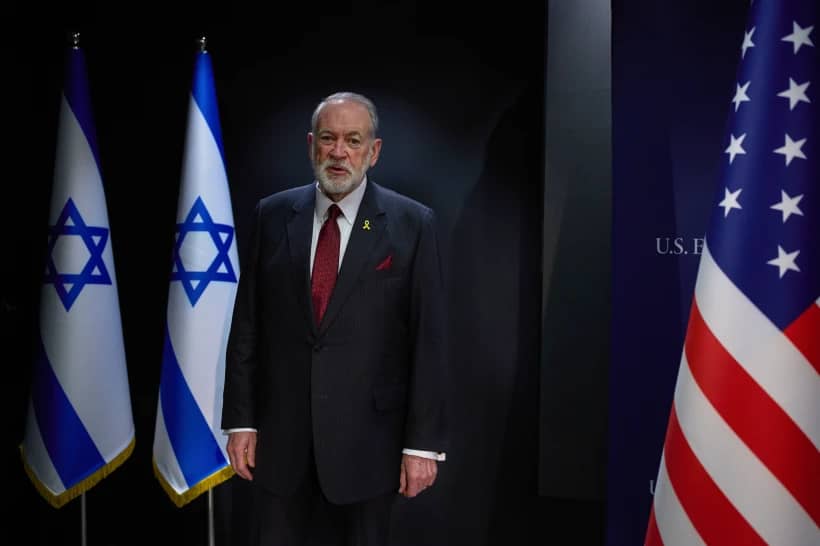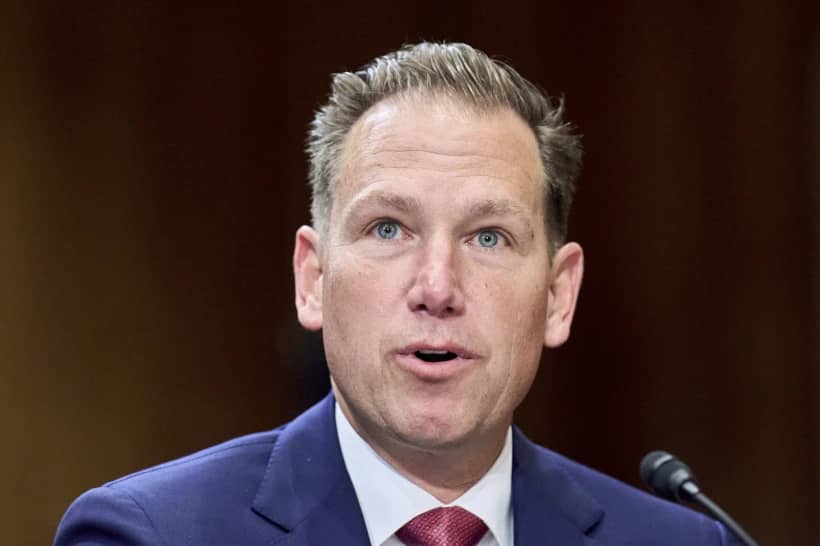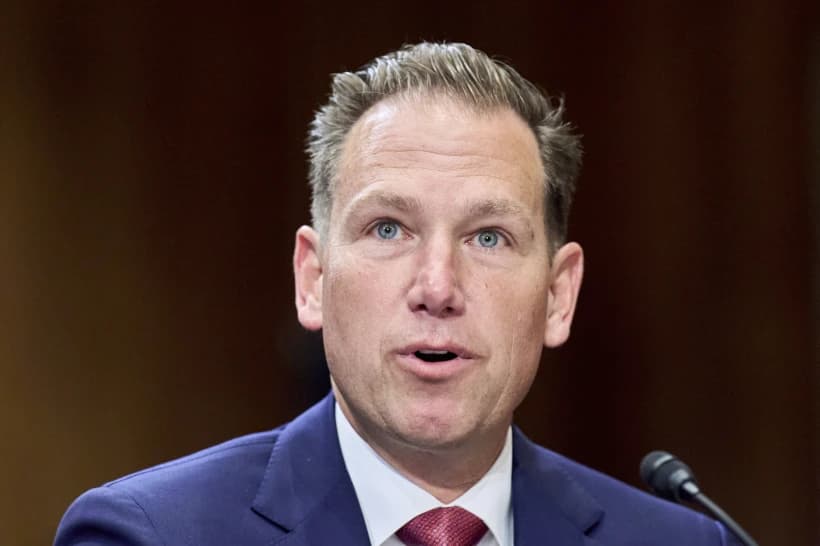
ROME – In a wide-ranging sit-down interview, new United States Ambassador to the Holy See Brian Burch addressed several hot-button foreign policy issues, including the conflicts in Ukraine and the Middle East, and the thorny issue of immigration.
Burch, a Catholic and former president of the Catholic Vote advocacy organization, also spoke about the Middle East, the recent U.S. actions in Venezuela and its engagement with Cuba, as well as his own transition from activist to diplomat, serving as the U.S. envoy to history’s first-ever pope from the United States.
Speaking to Crux Now from his office at the U.S. Embassy to the Holy See in an hour-long conversation, Burch addressed one of the most sensitive issues between the Catholic Church and the U.S. government, which is the issue of immigration and resistance among some Americans to comments Pope Leo XIV has made about it.
“The administration of our immigration law is something where I suspect the Holy See and the United States will never be perfectly aligned, but I think that there’s something important here to emphasize and that is, these are two sets of moral goods that are often in tension,” Burch said.
RELATED: US Ambassador sees potential for ‘Catholic Moment’ with Leo
Namely, he said, there is the U.S’s need “to protect the safety, security, and coherence of our laws,” and that is coupled with “the emphasis from the Holy See’s part to welcome the stranger, to provide a sense of welcome to the poor and vulnerable that are seeking better lives.”
“How you resolve those moral tensions is often not perfect,” he said, lamenting the recent killings of U.S. citizens by ICE immigration officials in Minneapolis.
What is important to remember on this issue, Burch said, is that “this is not a set of evil policies rooted in hate or xenophobia. That is a false claim that has never been true.”
“Instead, it is a set moral goods, namely the safety, security, and prosperity of our citizens that has been in tension with a set of policies that was chaotic and disorderly. And how we resolve that is never going to be perfect.”
What follows is Part One of Crux Now’s sit-down interview with U.S. Ambassador to the Holy See Brian Burch (Part Two is available here):
Crux Now: This has been a transition for you, internationally but also a transition in roles. How are you adjusting?
Burch: Transition is probably the right word, because it’s indeed been a transition in many different ways, both for myself professionally, for me personally, and with my wife, Sarah, and our children – as you probably know, we brought over a group of children, not all nine, but it has been an adjustment because we left behind a wonderful life, a wonderful Catholic community, a wonderful parish, schools, friends, all the things that we miss a lot. But we have this extraordinary honor of serving our country now in Rome and all of the beauty and richness of the Church here and the Embassy community.
Your arrival came right after the election of the first American pope in history. This is quite a special moment for U.S.-Vatican relations. How has that interaction with Leo been? What kind of tone does his American nationality set for your engagement?
It’s providential in many ways. When I was first nominated, Pope Francis was nearing the end of his papacy. You didn’t know, would that be a year or three years, but it was a papacy that had largely been defined and that I would be coming in as the US ambassador [with] all of the history there. Obviously, the passing of the Holy Father, and the election the first Pope from America is a distinction I think is important, a distinction that he and I talked about a bit when I met with him. It gives me the opportunity to really build on this relationship between the United States and the Holy See from a wholly unique perspective with the first pope from America at the start of his papacy, all of the newness that a new papacy brings. I feel like we’re in that early stage of this where so many things are developing and being defined from personnel to a pastoral and theological program that will mark his papacy and which will obviously go on much longer than me here, but I have a chance to be here from the very start.
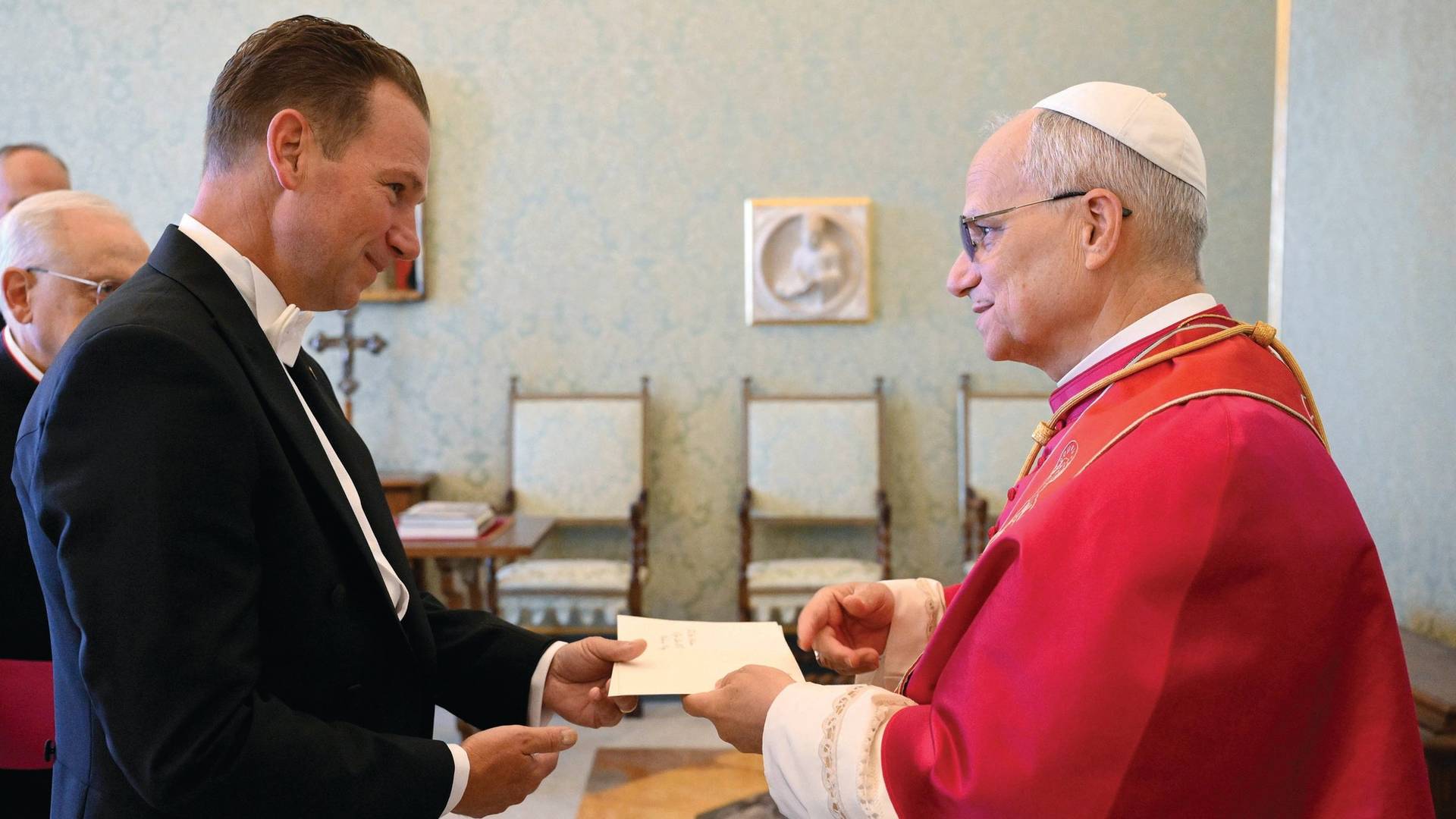
My interactions with him have been few. Most ambassadors see the Pope twice: They see him when they present their credentials and then when they leave. I did present my credentials in early September. They schedule those meetings for about 20 minutes or so. My meeting went almost 45 minutes, and I think we could have gone a lot longer, but for the fact that there were people waiting outside. We had lots of common connections in Chicago. As an American, we had this kind of easy way of talking to each other. He was extremely, extremely gracious, very easy to talk to. I think everyone sees this in his personality. He’s a very good listener, very reflective. We covered an array of things across a lot of different policies and questions. It was beyond any expectation I might have had. You go into those meetings somewhat apprehensive; the first time in the Apostolic Palace, you’re in his personal library, this is the pope. And then he starts talking to you in a Chicago accent and everything was wonderful after that.
One of the real gifts of the timing is that not just that it’s a new papacy, but a pope from America who I think naturally has an understanding of the United States and the uniqueness of the United States, and the uniqueness of the Catholic Church in the United States.
You certainly can’t say that he doesn’t understand what he’s talking about…
Certainly, although he has spent 30 years in Peru, so there’s a little bit of a debate between how Peruvian or South American has he become versus how American. This is a fun debate I had recently with the new Ambassador of the Holy See from Peru. We haven’t quite figured out exactly how much American and how much Peruvian he is.
It’s no secret that the Catholic Church and the current United States administration hold differing views on the issue of immigration. The recent killing of U.S. citizens by ICE agents has exacerbated tensions over this issue. Pope Leo has repeatedly advocated on behalf of migrants’ rights; nothing to do with policy, but for their spiritual needs and humane treatment. What is the US’s response to his appeals? How is his message being received?
The challenge of mass migration is not something that is unique to United States, this is something that Europe is experiencing, other parts of the world are dealing with it, and each of the countries are dealing with it in different ways. I think the Holy See and the United States share, in a fundamental sense, a lot in common. They want a legal, orderly process that respects the dignity of migrants, and respects the legitimate laws of the country. The Church is very explicit on this, that nations have a right to enforce their laws, have a write to enforce their border. Pope Leo said this outside Castel Gandolfo early in his papacy. And immigrants have a responsibility to respect the laws of their nation that they seek to enter.
The challenge of this administration is to bring order out of mass chaos. The president inherited a catastrophe at our border. Millions of people came across the border, many of them unaccounted for, children unaccounted for. The president was largely elected on his commitment to restoring order, protecting the safety and security of our citizens, and to enforcing the law. I think where there is potentially tension has been around how to safely, humanely, and effectively enforce our immigration laws. The catastrophe that our president inherited has not been easy to reform. I think he’s done a fantastic job of it so far. That doesn’t mean everything has gone perfectly.
You cite specifically the situation in Minneapolis. This is extraordinarily tragic. Watching this overseas was devastating to see. First, the violence and the attempts to impede law enforcement, and then the more significant tragic loss of life in the administration of the law. This was something that no one wanted, there’s a deep sense of sadness over the loss of life.
The administration of our immigration law is something where I suspect the Holy See and the United States will never be perfectly aligned, but I think that there’s something important here to emphasize and that is, these are two sets of moral goods that are often in tension: The need to protect the safety, security, and coherence of our laws, and the emphasis from the Holy See’s part to welcome the stranger, to provide a sense of welcome to the poor and vulnerable that are seeking better lives. And how you resolve those moral tensions is often not perfect.
The important thing here is this is not a set of evil policies rooted in hate or xenophobia. That is a false claim that has never been true. Instead, it is a set of moral goods; namely the safety, security, and prosperity of our citizens that has been in tension with a set of policies that was chaotic and disorderly. How we resolve that is never going to be perfect, but I commend our president for being someone willing to take it seriously and to engage with the Holy See and others on some of their concerns.
I have worked on the spiritual component of this. I worked with the Department of Homeland Security to ensure that those being detained do have access to the sacraments. I’ve helped the bishops of the United States to understand this. I think some of the claims that have been made have not fully understood the process. For example, detainees, when they’re first detained, are in a certain short-term facility before they’re put into a longer-term facility while their case is adjudicated, and the process for access to the sacraments has been totally consistent with law enforcement facilities.
I think that’s an important principle, that the U.S. government is not trying to deny anyone their religious rights. Often when there have been situations, it’s because the safety and security of both the detainees and the guards need to be protected in order to process the deportation in an orderly way.
A lot of people have this perception that the situation is still complete chaos. How at a policy level, or in the implementation phase, can the situation be calmed, and the impression given that this is not a public spat with Pope Leo, but a dialogue?
That’s a really important point. When I talk about the chaos, I was talking about the chaos at our border under the previous administration. I think the president has made tremendous strides towards bringing stability and order. There are some perceptions that the enforcement actions have created chaos. Part of this are people who don’t like him and don’t like the policies, and that have been creating all sorts of protests and obstruction.
The role of the Holy See Ambassador, though, is not to get into the midst of those domestic policy challenges and issues, as much as it is to help both sovereign states understand each other better. I have had a series of very productive, substantive, frank conversations at the Vatican around this, where I’ve tried to help explain our policy. I’ve walked them through the facts about access to the sacraments, about what the process is for detaining and deporting. I see my role not as an activist on that issue per se, but as someone who is trying to help the Holy See understand in an authentic way what exactly the president is doing.
Another policy move that created waves was the United States’s intervention in Venezuela. Pope Leo himself was wary about the U.S.’s actions there, and many are concerned that the U.S. might be preparing for similar action in Cuba and whether this is going to become a habitual way of acting by the U.S. In terms of Leo’s appeals for civil rights and respect for the sovereignty of a nation, how much weight does his voice carry when it comes to these foreign policy decisions? Is he being heard and taken seriously by the U.S. government?
I think anytime the Pope speaks, he’s taken seriously. The Holy See has an extraordinary moral authority given its history, its tradition, the respect due as a global institution with 1.6 billion followers. The Pope did speak in one Angelus about Venezuela, but I think it’s important to point out that the U.S. didn’t violate the sovereignty of Venezuela. [Nicolas] Maduro was not recognized as the rightful sovereign. He cheated and stole the election, and he was a convicted narco-terrorist that the U.S. enforced the law against in removing him.
I had a number of conversations with appropriate people inside the Vatican about Venezuela, including, as you probably saw in the Washington Post, where there was a series of efforts, both via the Vatican and elsewhere in our State Department, to try to find a peaceful resolution to this that didn’t require action on the part of the Department of War. Unfortunately, there was no interest on the part of Maduro to do that. I know our secretary [Marco Rubio] worked exceptionally hard to try to find a way out, and it turned out to be a path that he turned down, despite the best efforts, including my own, with the Holy See.
A follow-up to this is a question about the exercise of restraint. The pope, whoever he is, has always advocated for restraint in terms of these kinds of activities, even if it’s a longer route. John Paul II cautioned President George Bush not to invade Iraq, for example. In a hyper-polarized time, is there space for restraint anymore, even at the diplomatic level?
I think there always is space for restraint, and there always must be space for restraint. I think the Church is right to be that kind of defender of that option, the promoter of that high aspiration of humanity, that we can indeed resolve our conflicts through dialogue and better understanding and peaceful means. I think it’s a mistake to assume that somehow the United States or this president disagree with that in the exercise of the Department of War thus far, including at this moment with Iran. There were ongoing conversations in Venezuela that were going on for months to try to resolve the differences in a peaceful and justful way. That’s the job of diplomats.
Marco Rubio had a very poignant statement during my ambassador school class. He said the Department of State is the department peace. Our job is to resolve conflict, build consensus, and to work toward resolution of conflict in a peaceful way and when we fail the department of war takes over, and hopefully we never fail but occasionally dialogue and diplomacy do fail. And there have to be other answers.
I think for the Church’s sake, there are leaders in the Vatican have said the Church will always err on the side of this ideal. I think that’s something the world needs, including the United States, and we look to the Holy See to serve in that way. At the same time, the Church also, in its great tradition, understands that sometimes force can become justified, and I know those are in very limited circumstances where it would say so, but they have a just war theory not a just peace theory for a reason.
Today marks the fourth anniversary of the start of the full-blown war in Ukraine. Leo made an appeal about this, for an end to conflict and for dialogue, in his Sunday Angelus. At this point, what steps do you think can be taken to ensure that there is a genuine dialogue for a just and lasting peace and that everyone’s voices are heard in the process?
It’s a tragic anniversary that we mark today of the four years since the Russian invasion, but the truth is, this war started well prior to that when they invaded Crimea in 2014. This has been one of the primary areas of focus since I arrived because of the Holy See’s interest, given its place on the continent, and given the scale and loss of human life involved. I think the administration and the negotiating team that have been at work on this are doing everything possible to drive the parties to a ceasefire and then to a negotiation over terms that, as you rightly point out, are just and durable.
It’s also important to point out this has always been a war primarily fought in Europe and that the Europeans have involved the U.S. by necessity and that has informed a lot of the larger security discussions that are now underway relating to the U.S.-European alliance. This has always been a trilateral negotiation that involved the U.S., the Ukrainians, and the Russians. Clearly, the president would like nothing better than to notch yet another historic piece to go with the other places around the world that he’s already secured such an achievement, but I think the nature of this conflict is so difficult given the history, given Putin, given all the factors involved.
I think the best thing we can do is give the negotiators as much space as possible to get to the ceasefire, because the size and the scale of loss of life is beyond comprehension at this point. I don’t know if the world has recognized how terrible this war has become. Even in meetings just last week with the Vatican, the emphasis is, we have to do everything possible to stop the killing.
What space is there for international multilateral organizations at this point? Pope Leo and Pope Francis before him have lamented the weakening of bodies such as the United Nations, and this conflict involves the UN, the NATO alliance, etc. Is there still space for these organizations still in negotiations?
Multinational entities have large roles to play any time you’re in conflicts that involve many different nations. [Secretary Rubio’s] speech in Munich though pointed out some of the limitations and shortcomings: they weren’t able to repel Putin’s aggression, they weren’t able to repel Iran’s nuclear ambitions, they weren’t able to repeal Maduro’s narco-terrorism. So, there is a role for the United States to play as the leading economic and military power to try to press towards some of the solutions. It’s not an either-or, it’s a both-and.
I think we all recognize the United Nations has a role and will continue to have a role, but it has not been the most effective at resolving some of these big global challenges. I think the Holy See recognizes that too. They, of course, will always promote the idea that there can be these institutions where we gather and dialogue and resolve our conflicts, but the reality is, some of the recent history that I think the Holy See would acknowledge [is that] the UN has fallen short of what I think many believe what it once was.
Another important global hotspot in terms of conflict is the Middle East, which Pope Leo and I also spoke about in our own interview. He did not call Israel’s actions in Gaza a genocide at that point but noted that the term had been used more frequently. When it comes to the Israel-Palestine issue, the Vatican has always advocated for a two-state solution and a special status for Jerusalem. How realistic is it, in your view, that a lasting peaceful situation can be attained without these two conditions in place?
I don’t think it’s my place to say what the conditions need to be. This is why we have the Board of Peace. This is what we have the negotiators there, the teams that are trying to build some kind of consensus in a place in the world that has been fraught with division and conflict for decades, if not centuries. The challenges there are very complicated because it mixes a lot of geopolitical, economic, and even theological conflicts that have bubbled up in all sorts of ways, including in our own country, with all sorts of debates online that I don’t have enough time to spend trying to dive into.
President Trump helped bring about an end to this war. We are now in a place that we have not been in many years, where we have real conversations about what the future of this land and this region could look like. It involves Arab partners, it involves Muslim partners, and of course involves Israel, and involves leaders in Palestine to try to find a path that is sustainable and durable.
For me as the U.S. Ambassador to the Holy See, what is my role in that? Certainly, it’s to help inform the Holy See on our policies and what we’re doing there, but also to help build a working partnership around some of the areas where the Holy See can be of huge help. Specifically where we’re looking now is around point 18 of the 20-point peace plan, which involves the need for interfaith dialogue. In some ways, I think real honest assessment of the situation there is that without a greater understanding and dialogue around the questions, the tensions that involve religious faith, there can be no lasting peace. The Holy See has an extremely important role to play in that conversation.
You’ll – I’m sure – ask, what about the Board of Peace? Why didn’t the Holy See participate there? We had some really good conversations around this. I met with the Cardinal Secretary of State [Pietro Parolin], with [Cardinal Pierbattista] Pizzaballa, and with others. The Vatican was clear they don’t participate in governing bodies. The Board of Peace is designed specifically to build a technocratic and governing solution for this region. That doesn’t mean the Vatican has no role to play there, and I certainly look forward to working with them, particularly around this question of interfaith dialogue.
Do you think – and this is a question I think you can answer in the role that you have – is interfaith dialogue almost more important than diplomatic or political dialogue in this particular area of the world?
I think one doesn’t happen without the other. The root of so many of the challenges there is theological and religious, and I don’t think there can be a true lasting peace without real dialogue and a greater appreciation for the various religious sensibilities and priorities. There are other areas where we have worked around taxation issues, around visa issues, around the status of holy sites.
These are things, apart from the war and peace questions, that the Holy See does have a lot of interest in, and where the U.S. is very helpful. I work very closely with my counterpart and the embassy there, and we continue to work on some of these things that I think are of interest to the Holy See.
Follow Elise Ann Allen on X: @eliseannallen