SÃO PAULO, Brazil – Colombia’s highly polarized presidential election has become a source of concern for the nation’s Catholic Church, which has released a number of statements during the process in an effort to steer Catholics away from the paths of violence and irrationality.
The upcoming runoff, scheduled for Jun. 21, will pit right-wing candidate Abelardo de la Espriella against left-wing candidate Iván Cepeda, supported by incumbent Gustavo Petro. In the weeks leading up to the final vote, the intensity of the attacks exchanged by both sides has been increasing.
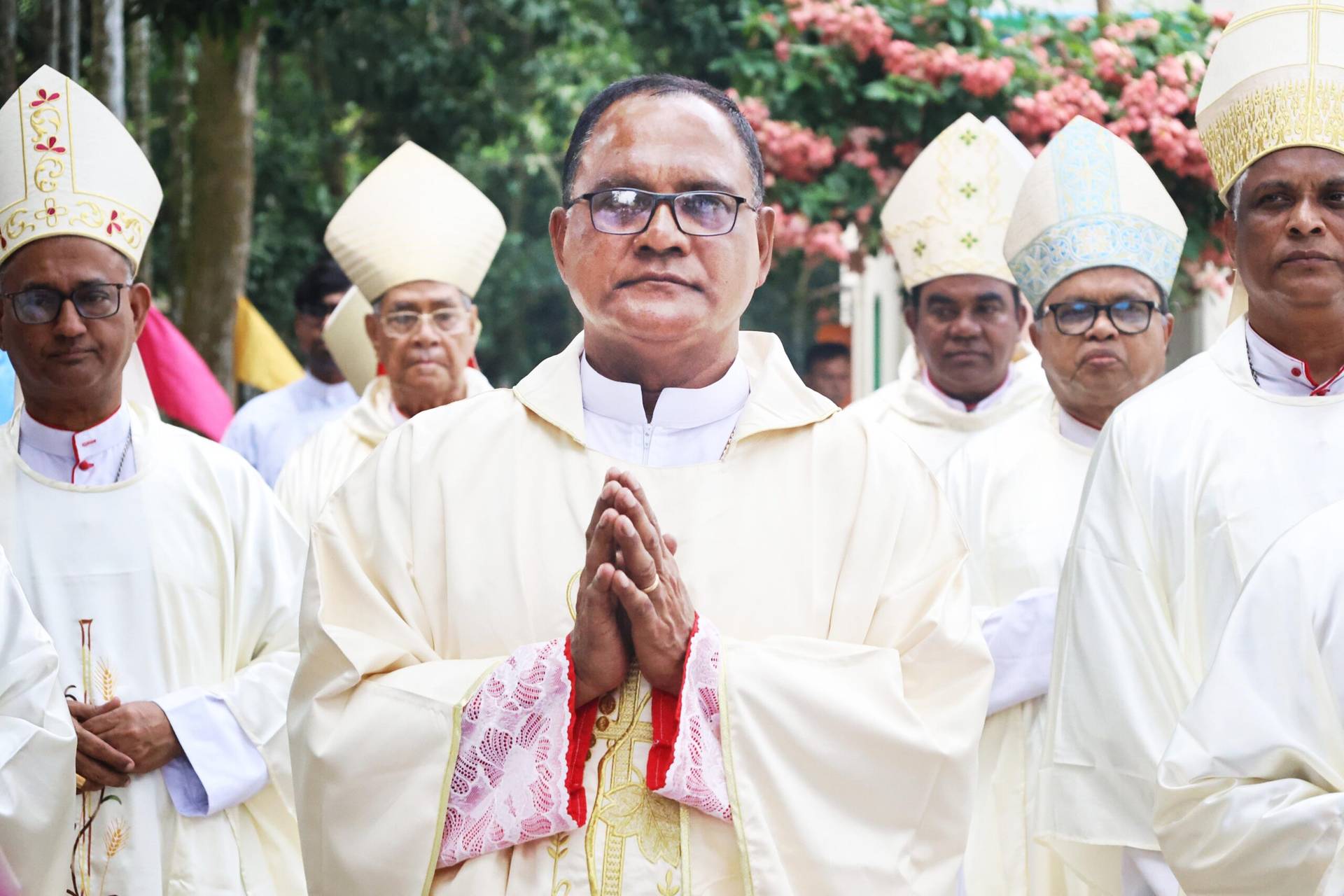
Bishop Juan Carlos Barreto of the Diocese of Soacha, who heads the Episcopal Commission for Social Ministry, told Crux Now the Church’s primary concern is the spread of violence.
“If candidates get into such a dynamic of attacking each other more and more, their supporters may become even more aggressive. They must set an example for their followers,” Barreto told Crux Now.
On Jun. 2, in fact, the bishops’ conference released a statement calling on the candidates to stop verbally attacking one another.
“[…] We share the concern of many Colombian men and women about the way the political campaigns of the candidates who have advanced to the electoral runoff are aggressively and shamelessly promoting a mindset that legitimizes verbal violence,” the letter read.
The campaign rhetoric has been more than merely contentious, and there had already been shocking incidents of political violence even before the presidential race got into swing.
After the announcement of the first-round results on May 31 – Cepeda obtained 40.98 percent of the vote and De la Espriella won 43.78 percent – the left-wing candidate launched a sharp attack, casting doubt on his opponent’s victory.
President Petro claimed the process had been rigged through the inclusion of 800,000 additional ballots that were not part of the official electoral registry and by irregular voting patterns at a number of polling stations. Senator Iván Cepeda endorsed the accusations, refusing to accept the result. Only the following day did he acknowledge De la Espriella’s first-round victory.
By then, however, De la Espriella had already escalated the confrontation, saying he would “defend democracy with reason or with strength” and urging the security forces to ensure that the election results were respected.
During the campaign, the right-wing candidate had already declared that he would “eviscerate the left” and displayed on a billboard an artificial-intelligence-generated image depicting him pinning Cepeda’s neck with his knee.
All such acts of symbolic aggression have been accompanied by real violence. In May alone, at least four politicians were shot dead, including De la Espriella’s campaign coordinator in the city of Cubarral, in Meta Department.
In fact, political violence had already manifested itself even before the presidential race began. In a shocking incident, Senator Miguel Uribe Turbay, who hoped to secure his party’s presidential nomination, was shot three times during a rally in Bogotá in June 2025. He was hospitalized and died in August.
The bishops’ June 2 statement also urged “the candidates to focus their attention on widely presenting their plans for governing the country, their responses to the population’s most pressing needs, and their commitment to govern for all citizens, always seeking the common good, equity, justice, unity, forgiveness, reconciliation, and peace.”
A priest and longtime peace negotiator in Colombia, Father Héctor Henao, is also concerned about the prospect of increased violence.
“The goal is to prevent the situation from escalating into greater violence. When political discourse is based on insults and personal attacks rather than proposals, it creates conditions for further violence,” Henao told Crux Now.
Henao represented the Church throughout the peace process between the government and left-wing guerrilla groups, such as the National Liberation Army (known by its Spanish acronym, ELN).
President Petro had pledged that his administration would achieve “total peace” with those organizations, as well as with right-wing paramilitary groups and criminal gangs. While some agreements have been reached, Petro is nearing the end of his term far from having achieved that goal.
Father Tarcisio Gaitán, a theology professor at the Pontifical Bolivarian University in Medellín, said Petro’s “total peace” initiative could never have been achieved within a single four-year term. Nevertheless, he argued that concrete progress has been made.
“In different regions, there have been advances. Illicit crops were eradicated and kidnappings declined. Victims were heard, and people experienced a period of relative calm for the first time in years because the number of armed confrontations was reduced,” Gaitán told Crux Now.
But violence perpetrated by guerrilla groups and other armed organizations continued to affect many parts of the country, creating a wide range of perceptions regarding the government’s efforts, he said.
“In the central part of Colombia, that progress has not been felt. That helps explain why De la Espriella enjoys stronger support there,” Gaitán said.
Indeed, widespread violence has been a central concern among Colombian voters. Cepeda has pledged to continue pursuing negotiations with armed groups, while De la Espriella has said he would not engage in dialogue with them.
“In Colombia, which is overwhelmingly Christian, almost everyone longs for peace. The challenge lies in the different understandings of what peace means,” Gaitán said.
At the same time, political and social differences have historically been addressed through violence, he added.
For Father Rafael Castillo, former director of Caritas Colombia and now rector of the Cathedral of Cartagena de Indias, decades of political violence have demonstrated that aggression is never justified.
“It is a mistake to believe that the evils afflicting Colombia can be overcome with more evil, or that injustice can be defeated with injustice,” he told Crux Now.
Respect for every man and every woman “calls us to make a constant effort to put an end to mutual violence and to promote dialogue and the shared pursuit of an ever more just and fraternal coexistence,” he concluded.
Bishop Barreto agrees.
“Pope Leo XIV speaks of an unarmed and disarming peace. Peace cannot be achieved through war,” he said.